
Domestic Helper for Cancer Care in Singapore
Shortlist and train a domestic helper for cancer care with a defined home role, treatment-day routine, infection plan and professional backup.
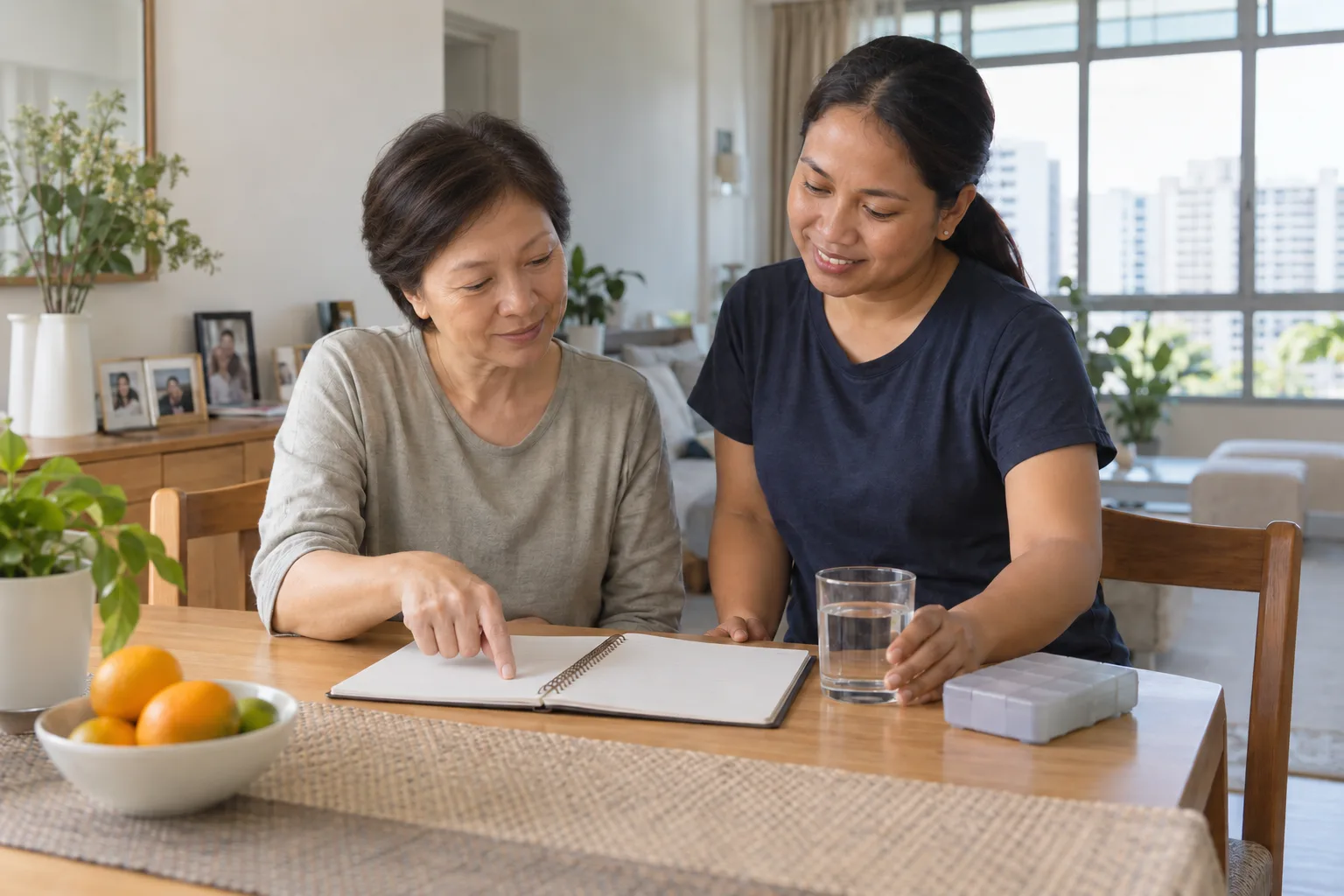
Cancer care at home is not one fixed job. Needs can change between treatment cycles and may range from transport and meals to personal care, mobility support or symptom observation. A suitable domestic helper should be chosen for the patient’s current plan, trained for the tasks she will actually perform and backed by a family member who owns clinical decisions and emergency communication.
Define the home role before reading biodata
The National Cancer Centre Singapore’s caregiving guide describes cancer support as a mix of daily activities, learning about treatment, medication management, side-effect awareness, mobility, personal care and emotional support. Ask the patient what help is wanted, then ask the cancer team which tasks require demonstration, written instructions or a qualified provider.
| Need | Possible helper support after training | Family or professional owner |
|---|---|---|
| Treatment days | Prepare the agreed bag, meals and transport handover | Family confirms appointments and clinical instructions |
| Medicines | Prompt or assist only as written and taught | Prescriber or pharmacist sets the regimen |
| Meals and fluids | Prepare the prescribed or preferred food safely | Dietitian or care team sets restrictions when needed |
| Personal care | Support bathing, dressing and toileting with consent | Patient chooses privacy and level of help |
| Mobility | Use only the taught technique and equipment | Therapist assesses transfer and walking method |
| Symptoms | Observe, record and call the named contact | Cancer team assesses and treats |
Do not assume that a candidate who cared for one person with cancer can reproduce the same routine for another. Diagnosis, treatment, surgery, devices, infection risk and independence differ. Separate ordinary household work from close supervision so the job is possible within real time and with weekly rest.
Interview for accurate follow-through, not a nursing label
Ask the candidate to describe one previous care role in verbs: what she prepared, recorded, cleaned, observed and reported. Then give her a sample timetable and ask her to explain it back. A good response protects the patient’s choices, follows written instructions, notices change and escalates early. It does not promise to handle every medical situation alone.
- What did you personally do for the patient, and what did a nurse or family member do?
- How would you record a new symptom before calling the family?
- What would you do if the patient refuses food, a shower or an activity?
- How would you respond if the written medicine instruction is unclear?
- How do you reduce infection risk during food preparation and personal care?
- Which tasks would you need a nurse or therapist to teach you at home?
Check references for reliability, privacy, respectful communication and whether the described duties match the biodata. Do not conduct a transfer demonstration with a real patient before employment and training. A family should never recruit around an unverified claim such as “trained nurse” without confirming credentials and the legal role being offered.
Build a one-page treatment and escalation plan
NCCS advises caregivers to keep an up-to-date medication list, carry it to appointments and avoid starting medicines or supplements without consulting the doctor because of possible interactions with anti-cancer treatment. The helper should use the current written list; she should not change timing, double a missed dose, crush tablets or add a supplement based on past experience.
| Write down | Why it matters | Boundary |
|---|---|---|
| Current medicine list and exact instructions | Reduces memory-based errors | Only the clinical team changes it |
| Usual symptoms and treatment-cycle pattern | Gives the household a baseline | A pattern does not rule out a new problem |
| Who to call during and after clinic hours | Creates a clear escalation route | Use emergency services for an emergency |
| Food, fluid and hygiene instructions | Makes daily support consistent | Do not invent a restrictive diet |
| Device or wound instructions | Identifies trained tasks and red flags | Untrained procedures stay with professionals |
| Patient’s privacy and help preferences | Preserves control and dignity | Consent should be checked, not assumed |
Treat fever and infection instructions as patient-specific
NCCS’s fever and infection guidance says even a low-grade fever during cancer treatment can become serious and advises early contact with the care team. It lists warning signs including chills, confusion, breathing difficulty and redness or discharge around a catheter site. The household should use the patient’s own oncology instructions and thermometer plan rather than relying on a generic internet threshold.
Teach hand hygiene, safe food preparation and any device precautions specified by the clinical team. The helper should not conceal symptoms to preserve an appointment schedule, decide that a fever is harmless, or give leftover antibiotics. If severe breathlessness, confusion or another emergency sign occurs, follow the clinical emergency plan and use 995 when appropriate.
Preserve independence and emotional privacy
Fatigue can vary from day to day. Offer help, allow extra time and let the patient do every task that remains safe and wanted. Avoid discussing the diagnosis with visitors, neighbours or other helpers without permission. Listening is useful; forcing optimism, giving medical opinions or reporting every private conversation to the wider family is not.
NCCS’s caregiver-support resource recognises the physical and emotional impact of cancer on patients and caregivers. Include the helper in practical teaching and debriefing, but do not make her the sole emotional support for the patient or the family.
Train the whole backup team
AIC’s Caregivers Training Grant can subsidise approved caregiver courses for eligible care recipients, including when the main caregiver is a migrant domestic worker. Choose training that matches the actual personal-care, transfer, equipment or emergency skills; a general certificate is not a substitute for the patient’s discharge or oncology teaching.
Use family cover and suitable services so the helper can take rest days and sleep. AIC’s respite-care guidance lists home and centre-based options, while NCCS points caregivers to home nursing, home personal care, day care and medical escort. Escalating needs may require professional care rather than a longer helper task list.
For broad hiring criteria, use the elderly-care helper guide. For a transition from hospital, use the post-discharge care guide. For transfer technique and equipment, use the wheelchair and mobility guide.
How this guide avoids overlap
This guide owns cancer-specific helper matching: treatment-cycle routines, medication boundaries, infection escalation and oncology-team handover. The elderly-care guide owns general screening, the post-discharge guide owns hospital-to-home preparation, and the wheelchair guide owns mobility equipment and transfer technique across diagnoses.
Sources and review note
Reviewed on 6 October 2026 against current National Cancer Centre Singapore caregiving and infection guidance, plus Agency for Integrated Care training, routine-planning and respite information. The patient’s cancer team must provide the individual medicine, symptom, device and emergency plan.
Frequently asked questions
Can a domestic helper care for someone with cancer in Singapore?
A helper can support daily living, meals, appointments, observation and tasks that the patient, family and cancer team have defined and taught. She does not replace an oncology nurse, change medication, diagnose an infection or independently perform a clinical procedure.
What should I ask when interviewing a helper for cancer care?
Ask for exact examples of personal care, mobility, meal preparation, appointment support and record-keeping. Use scenarios about fever, a missed medicine and sudden weakness. Look for calm escalation and willingness to follow a written plan rather than confidence without limits.
Can a domestic helper use the Caregivers Training Grant for cancer-care skills?
AIC says a migrant domestic worker may use the Caregivers Training Grant when she is the main caregiver and the care recipient meets current scheme criteria. Cancer alone does not automatically establish eligibility, so confirm the recipient’s age, nationality or disability criteria and the approved course with AIC.
Official references
These primary references support the guide. A verification date is shown only after a dated editorial review.
- Providing care for someone with cancer — National Cancer Centre Singapore (checked 6 Oct 2026)
- Fevers and infections during cancer treatment — National Cancer Centre Singapore (checked 6 Oct 2026)
- Caring for caregivers supporting someone with cancer — National Cancer Centre Singapore (checked 6 Oct 2026)
- Caregivers Training Grant — Agency for Integrated Care (checked 6 Oct 2026)
- Respite care and taking a break from caregiving — Agency for Integrated Care (checked 6 Oct 2026)
- Planning a care routine — Agency for Integrated Care (checked 6 Oct 2026)
- Rest days and well-being for migrant domestic workers — Ministry of Manpower Singapore (checked 6 Oct 2026)