
Domestic Helper After Hospital Discharge Singapore: Care Guide
How Singapore families can shortlist and train a helper for post-discharge support, define care boundaries, prepare the home, and arrange professional backup.
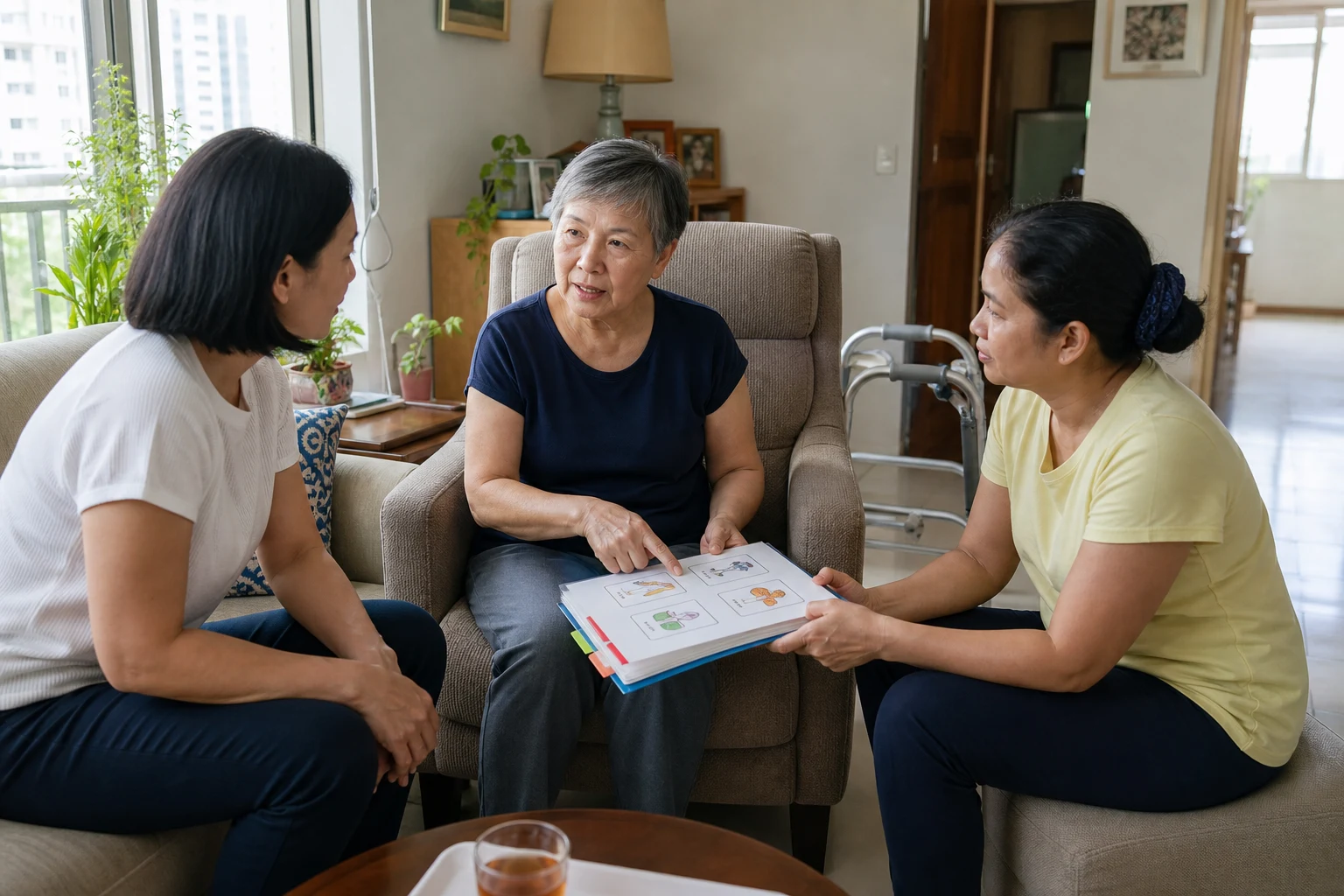
Hiring a domestic helper after a hospital discharge can support recovery at home, but discharge does not automatically mean care is simple or safe for an untrained person. The family should first understand what changed, what the recovering person can do independently, which tasks require training or professional care, and how follow-up and emergencies will be managed. Only then can biodata and interviews be matched to the real role.
Quick answer
Before hiring, ask the hospital team for a written discharge plan and task-by-task caregiver training. Shortlist helpers using verified experience, interview with realistic scenarios, and observe practice with the actual person and equipment. Keep diagnosis, medication changes, wound assessment, rehabilitation decisions, and other clinical judgement with healthcare professionals. Arrange home-care or nursing support when the plan exceeds household caregiving.
Build the care plan before the job description
AIC’s discharge preparation checklist asks families to clarify daily activities, medication changes, follow-up appointments, emergency signs, supplies, feeding, mobility, toileting, showering, transport, and home safety. Use those questions with the discharge nurse, pharmacist, therapist, doctor, and medical social worker before converting the plan into helper duties.
| Care area | Document before discharge | Set the boundary |
|---|---|---|
| Daily living | Bathing, dressing, toileting, meals and independence level | Prompt, supervise or assist only as trained |
| Mobility | Walking aid, transfer method, weight-bearing and fall plan | No improvised lifting or exercises |
| Medication | Current list, timing, storage, reminders and escalation | No dose or treatment changes |
| Clinical care | Dressings, tubes, devices, monitoring and provider | Qualified service or specifically trained caregiver only |
| Appointments | Dates, transport, preparation, documents and questions | Family owns consent and decisions |
| Emergency | Warning signs, who to call, nearest route and key records | Escalate; do not diagnose |
Shortlist from evidence, not a “caregiver” label
Review current elderly-care helper profiles, but ask what each candidate actually did. Care after a fracture, stroke, surgery, infection, or long admission can involve very different mobility, cognition, nutrition, toileting, equipment, and follow-up needs. Confirm the care recipient’s assistance level, the candidate’s training, which professionals supervised her, and which tasks she never performed.
- What could the person do independently when you started and when the job ended?
- Which transfers, personal-care tasks, meals, devices, or records did you handle?
- Who trained and observed you, and did the method change after review?
- How did you report pain, confusion, poor intake, falls, or other changes?
- Did a nurse or therapist visit, and how did you hand over observations?
- Which care tasks would you refuse until properly trained?
Use post-discharge interview scenarios
| Scenario | Ask | Safe answer signals |
|---|---|---|
| Transfer method feels unsafe | Would you continue? | Stops, keeps person safe, calls family or therapist, does not improvise |
| Medication list conflicts with an old routine | Which do you follow? | Checks current written instructions with family or professional |
| The person eats or drinks less | What would you do? | Records facts, follows the escalation plan, seeks timely advice |
| A dressing appears different | Would you change the treatment? | Does not assess or alter care beyond training; contacts provider |
| Follow-up transport fails | What is your backup? | Calls named contact, keeps person safe, rearranges through authorised route |
Train the person who will perform the task
If the helper will assist with a transfer, shower, feeding plan, device, exercise, or observation record, she should attend the relevant demonstration and practise under supervision. Video or written instructions can reinforce training but should not replace hands-on assessment for a person-specific task. Ask the professional what could go wrong, when to stop, how to protect both people, and who will review technique at home.
AIC states that eligible migrant domestic workers who are the main caregivers of qualifying care recipients may use the Caregivers Training Grant for approved courses. Verify eligibility and choose training for the actual post-discharge tasks rather than a broad certificate that does not match the person’s needs.
Prepare the home before the person returns
- Clear the route between bed, toilet, dining area and entrance.
- Install only equipment or modifications recommended for the person and practise using them.
- Store current medication and supplies securely, with old items separated for family review.
- Place emergency contacts, discharge summary location and appointment information where authorised caregivers can find them.
- Set up lighting, seating, footwear, bathroom support and clutter control for the assessed mobility level.
- Give the helper safe accommodation and privacy; a recovering person’s needs do not remove employer obligations.
Keep records factual and decisions with the right person
A useful daily record can cover meals and fluids as instructed, sleep, toileting, mobility, completed reminders, appointments, exercises prescribed by a professional, and observed changes. The helper records facts and contacts the named family member or provider. She should not interpret test results, change medication, promise recovery outcomes, consent to treatment, manage the person’s money, or conceal a mistake because the family is busy.
Add professional and respite support where needed
AIC’s Enhanced Home Personal Care service describes trained professionals who can provide personal care and certain advanced tasks, subject to assessment and service availability. AIC also lists respite options for temporary support. Ask the hospital or polyclinic about suitable referrals; a domestic helper is one part of the care network, not a substitute for home nursing or rehabilitation.
Use a staged first week at home
- Before arrival: confirm equipment, supplies, transport, contacts, training and the first follow-up.
- Day 1: family leads the discharge handover and observes every priority care task.
- Days 2–3: helper practises agreed daily-living support while family checks technique and records.
- Days 4–7: review pain or symptom escalation, mobility, meals, toileting, sleep, workload and the home setup with the appropriate professional.
- End of week: reclassify each task as independent, supervised, professional-only, or not required.
Protect the helper’s rest and backup the role
Recovery may involve nighttime toileting, repositioning, worry, or repeated calls for help. Parents or other family members should share on-call coverage, reduce daytime chores after broken sleep, and arrange professional or family backup for rest days, illness, and appointments. Fatigue increases risk for the care recipient and the helper; it is a care-plan problem, not a character flaw.
How this guide avoids overlap
This page owns the time-limited hospital-to-home transition, discharge handover, training, and service-boundary intent. For ongoing general senior support, use the elderly-care helper guide; for individual transfer and wheelchair planning, use the mobility-care guide; for dementia-specific support, use the dementia-care guide.
Sources and review note
Last reviewed 1 September 2026. Primary references: AIC discharge preparation, caregiver training, home personal care, respite, and home-safety resources plus MOM contract and rest-day guidance, linked above and listed below. This is a hiring and care-coordination guide, not medical, nursing, rehabilitation, or emergency advice.
Frequently asked questions
Can a domestic helper provide care after hospital discharge?
A helper can support agreed daily living, meals, mobility, observation, reminders, appointments, and household routines when she has task-specific training and family oversight. Nursing procedures, clinical assessments, treatment changes, and tasks beyond her training should remain with qualified professionals.
When should caregiver training happen?
Ask the hospital team what training is needed before discharge and include the actual person who will perform each task. Repeat training at home when equipment or the environment changes. AIC also lists approved courses and support through the Caregivers Training Grant for eligible caregivers.
What if the care need is too complex for one helper?
Tell the hospital care team before discharge and ask about home nursing, home personal care, rehabilitation, respite, equipment, or other community services. Use trained professional care for advanced or clinical tasks and keep family backup for rest days, illness, and emergencies.
Official references
These primary references support the guide. A verification date is shown only after a dated editorial review.
- Preparing for hospital discharge and care at home — Agency for Integrated Care (checked 1 Sept 2026)
- Caregivers Training Grant — Agency for Integrated Care (checked 1 Sept 2026)
- Enhanced Home Personal Care services — Agency for Integrated Care (checked 1 Sept 2026)
- Respite care and taking a break from caregiving — Agency for Integrated Care (checked 1 Sept 2026)
- Making your home safe — Agency for Integrated Care (checked 1 Sept 2026)
- Contracts and safety agreement for migrant domestic workers — Ministry of Manpower Singapore (checked 1 Sept 2026)
- Rest days and well-being for migrant domestic workers — Ministry of Manpower Singapore (checked 1 Sept 2026)