
Domestic Helper for Wheelchair and Mobility Care Singapore
A Singapore guide to shortlisting and training a helper for wheelchair and mobility support, with safer transfers, home planning, dignity, and backup care.
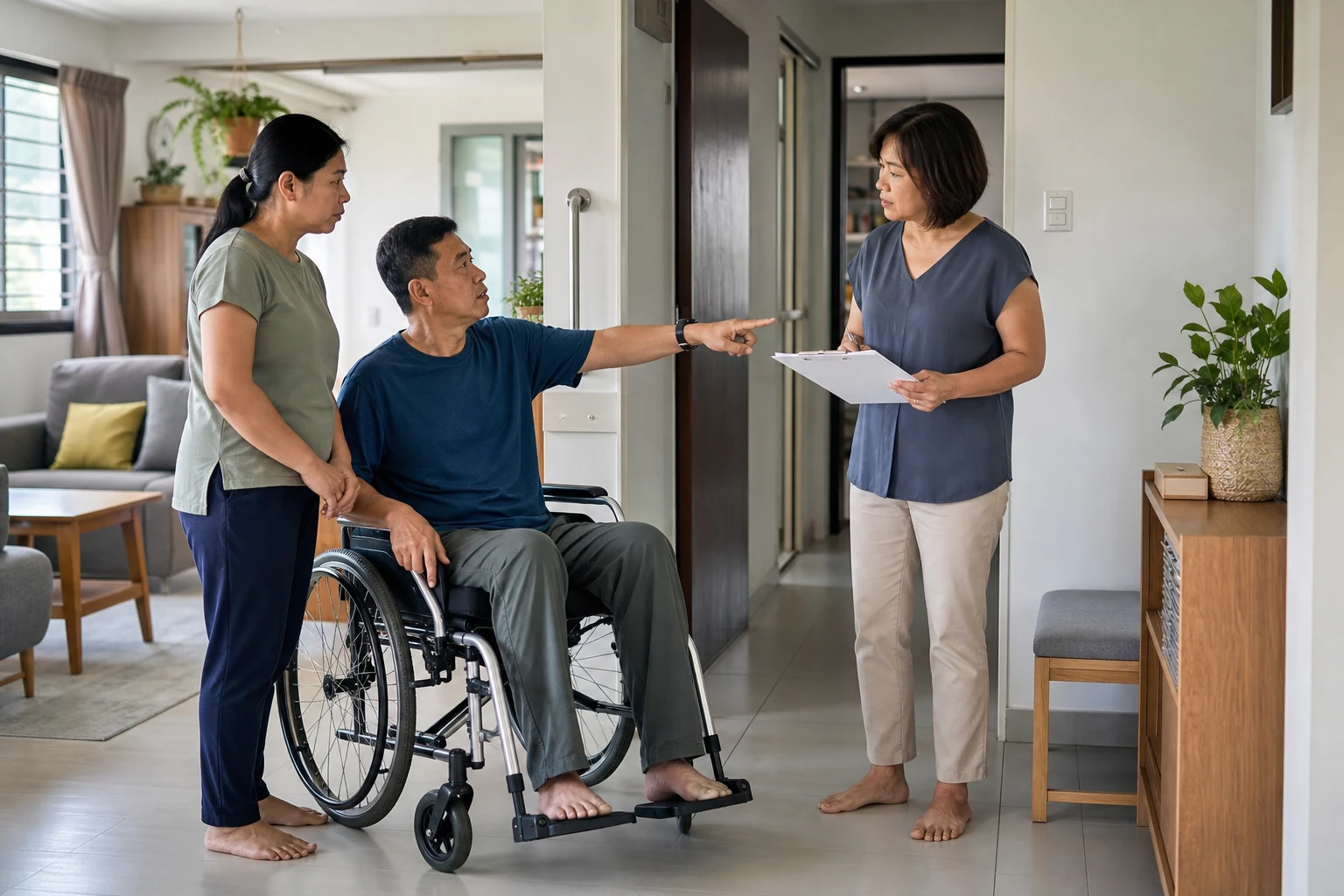
A domestic helper supporting a wheelchair user or person with reduced mobility needs more than physical strength. Safe care depends on an individual mobility plan, correct equipment, practical training, an accessible home, calm communication, respect for the person's choices, and backup when a task needs two people or professional help.
Quick answer
Ask a physiotherapist, occupational therapist, nurse, or other qualified professional to define the person's mobility and transfer plan. Shortlist helpers whose past duties can be verified, interview through scenarios, and arrange hands-on training with the actual equipment. Never ask one helper to lift, catch, or transfer a person in a way that is unsafe for either of them.
Define the level of assistance precisely
| Need | What the brief should state | Who should define the method |
|---|---|---|
| Walking support | Distance, aid, pace, fatigue, stairs, and supervision level | Care team or treating professional |
| Wheelchair use | Manual or powered chair, brakes, footplates, cushions, route, and transport | Wheelchair user and relevant professional |
| Transfers | Independent, standby, one-person, two-person, or equipment-assisted | Qualified professional after individual assessment |
| Personal care | Toileting, bathing, dressing, positioning, and privacy preferences | Care recipient, family, and care professional |
| Falls and emergencies | What not to do, who to call, and when emergency help is needed | Healthcare professional and family |
| Community access | Lift, kerb, ramp, transport, weather, and destination accessibility | Wheelchair user and family |
Do not write “must be able to lift adult” as a job requirement. Manual lifting can injure the care recipient and helper. If the current method feels difficult, painful, rushed, or dependent on catching someone, stop and request reassessment rather than searching for a stronger candidate.
Verify real experience, not a mobility tag
Browse elderly-care helper profiles, then ask what each mobility claim means. A candidate may have pushed a wheelchair outdoors but never assisted with a transfer; another may have supported a person who could stand with guidance; a third may have used a hoist under nurse supervision. These are different roles.
- What could the care recipient do without help?
- Which mobility aid or transfer equipment was used?
- Who assessed and taught the procedure?
- Which tasks required two people?
- How did you protect privacy during toileting, bathing, and dressing?
- What did you do after a near fall, pain, skin concern, or sudden change?
Use safety scenarios in the interview
| Scenario | Ask the candidate | Strong answer signals |
|---|---|---|
| The person feels dizzy before standing | What do you do? | Stops, keeps the person safe, observes, and escalates |
| The wheelchair footplate blocks a transfer | Would you continue? | Checks the trained setup instead of forcing the movement |
| A family member asks for a faster lifting method | How would you respond? | Uses the approved method and asks for reassessment |
| The person falls | Would you lift immediately? | Follows the individual fall and emergency plan; does not improvise |
| A route has a new obstacle | How do you plan the trip? | Discusses accessibility, alternatives, time, and the person's preference |
Arrange hands-on, person-specific training
AIC's Caregivers Training Grant page describes approved training for eligible caregivers and highlights programmes based on a care recipient's mobility condition. A domestic helper may use the grant when she is the main caregiver of an eligible person and completes an approved course.
General training builds foundations, but the final handover should use the person's own wheelchair, bed, bathroom, mobility aid, sling, ramp, and transport routine. Ask the trainer or treating professional to observe the helper performing each critical step and to write down what requires one person, two people, or equipment.
Adapt the home before blaming technique
AIC's home-safety guidance recommends assessing hazards and notes that changes such as improving lighting, rearranging furniture, and installing suitable fittings can reduce fall risk. An occupational therapist or healthcare professional can assess individual needs.
- Measure doorways, turning space, bed height, and bathroom access with the actual wheelchair.
- Keep transfer areas dry, uncluttered, and consistently arranged.
- Store frequently used items within safe reach of the wheelchair user and helper.
- Check brakes, cushions, footplates, battery charging, and other equipment according to instructions.
- Plan emergency access so responders can reach the person.
- Review the setup after any fall, hospital stay, pain, weakness, or equipment change.
Protect dignity, choice, and privacy
Speak to the wheelchair user, not only to the family or helper. Ask how and when assistance should be offered, which words are preferred, what can be done independently, and how privacy should be protected. The goal is safe participation and autonomy—not completing every task for the person as quickly as possible.
Plan for two-person tasks and rest days
Identify in writing which transfers, stairs, bathing situations, outings, or emergencies need a second adult or professional. Schedule family, home-care, or respite support before the helper's weekly rest day and home leave. Night repositioning or toileting can create chronic fatigue; review the plan if one person cannot obtain safe sleep.
Check support schemes without assuming eligibility
The Home Caregiving Grant may help eligible families with the cost of home care, a helper, or healthcare items. MOM's MDW levy-concession guidance describes the route for a person certified as needing help with at least one activity of daily living. The schemes use different criteria, so verify assessment, residence, nationality, and means-test requirements separately.
A safe onboarding sequence
- Before arrival: obtain the current professional mobility and equipment plan.
- Days 1–3: family or trainer demonstrates; helper observes and asks questions.
- Week 1: helper practises with direct supervision and no rushed transfers.
- Week 2: professional checks technique with the actual home setup where possible.
- Weeks 3–4: confirm independent, supervised, two-person, and out-of-scope tasks.
- Ongoing: reassess after any meaningful change in function, pain, equipment, or home layout.
How this guide avoids overlap
This page owns wheelchair use, mobility assistance, transfer training, and accessible-home planning. For broad eldercare screening, use the elderly-care helper guide. For dementia-specific communication and behaviour support, use the dementia-care helper guide.
Sources and review note
Last reviewed 29 August 2026. Primary references: SG Enable's physical-disability Caregiver Learning Roadmap, AIC training, home-safety and caregiving-grant pages, and MOM levy, contract, and rest-day guidance. Individual transfer and mobility methods require qualified professional assessment.
Frequently asked questions
Can a domestic helper transfer someone between a bed and wheelchair?
Only when the transfer has been individually assessed, the helper has been trained in the recommended method and equipment, and the task can be performed safely. Families should not rely on strength, improvisation, or a generic online technique.
What mobility experience should I verify?
Ask about the care recipient's level of assistance, exact transfer method, mobility equipment, personal-care duties, fall response, professional supervision, and what the candidate handled independently. A wheelchair tag alone is not evidence of safe transfer skill.
Is caregiver training support available in Singapore?
AIC says eligible family caregivers and domestic helpers may use the Caregivers Training Grant for approved courses. Families should select training matched to the care recipient's mobility condition and verify current eligibility with AIC.
Official references
These primary references support the guide. A verification date is shown only after a dated editorial review.
- Caregivers Training Grant — Agency for Integrated Care (checked 29 Aug 2026)
- Making your home safe — Agency for Integrated Care (checked 29 Aug 2026)
- Home Caregiving Grant — Agency for Integrated Care (checked 29 Aug 2026)
- Levy concession for a migrant domestic worker — Ministry of Manpower Singapore (checked 29 Aug 2026)
- Caregiving for persons with physical disabilities — SG Enable – Enabling Guide (checked 29 Aug 2026)
- Contracts and safety agreement for migrant domestic workers — Ministry of Manpower Singapore (checked 29 Aug 2026)
- Rest days and well-being for migrant domestic workers — Ministry of Manpower Singapore (checked 29 Aug 2026)