
Domestic Helper Sleeping Arrangements in Singapore
Plan a lawful, respectful sleeping space for a domestic helper in Singapore, with practical checks for privacy, ventilation, safety, storage and rest.
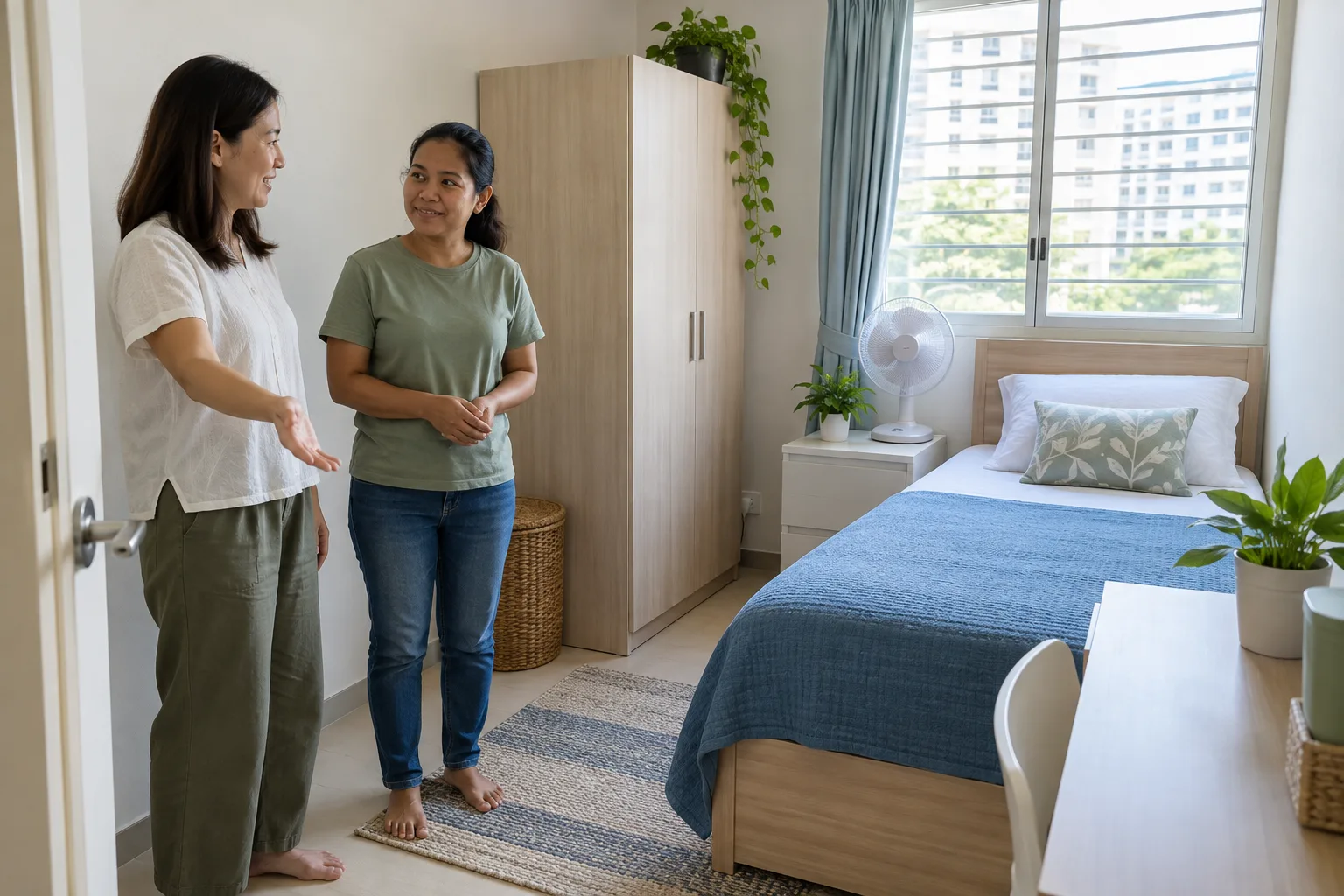
A sleeping arrangement is not a detail to solve after a helper arrives. It is part of deciding whether your home can support a live-in employment relationship at all. Show the proposed space during recruitment, describe who uses adjacent areas and resolve privacy, ventilation, storage and nighttime noise before a candidate accepts the role. The strongest plan is one that remains suitable every night, not only when the home is tidy for an interview.
Use MOM’s accommodation requirements as the starting point
MOM’s rest days, health and well-being guidance says an MDW’s accommodation must provide adequate shelter, basic amenities, sufficient ventilation, safety, modesty, space and privacy. Employers should provide a separate room; where that is not possible, they must still provide adequate space and privacy. A mattress, pillow, blanket, bathroom amenities and toiletries are minimum basics, not optional perks.
| Requirement | Inspect in your home | Do not treat as sufficient |
|---|---|---|
| Shelter | Protected from sun, rain and strong wind | A temporary curtain beside a balcony |
| Ventilation | Working natural airflow or mechanical ventilation | A closed storeroom with no adequate airflow |
| Safety | Clear exits and no dangerous equipment or wet area | A bed beside tools, appliances or a toilet |
| Modesty | Private changing and sleeping arrangements | Sharing with a male adult or teenager |
| Space and privacy | A usable bed area and boundaries from household traffic | A mattress moved away every morning |
| Amenities and storage | Bedding, toiletries and secure personal storage | Expecting all belongings to remain in luggage |
Walk through the space at the hours when it will actually be used. A living area may appear quiet at noon but become a television room late at night or a walkway early in the morning. Check light, noise, air-conditioning or fan access, access to the bathroom, charging points and whether doors or partitions allow meaningful privacy. Do not ask a candidate to agree to a vague “we will work something out” arrangement.
Do not confuse a small home with permission to remove privacy
MOM’s pre-hiring accommodation checklist asks employers to consider before hiring whether they have room for proper accommodation with enough space, ventilation, safety, privacy and protection from the elements. In a compact flat, measure the proposed area and map when other family members need to pass through it. A folding screen or storage divider may help only if the underlying space is already safe and allows genuine rest and changing privacy.
Do not assume a household shelter, service yard, kitchen corner or living-room sofa is acceptable because furniture can physically fit. Assess the actual conditions against every requirement. If the only available option is a shared room, disclose who would share it, their age and gender, and how privacy and sleep will be protected. MOM explicitly states that an MDW must not sleep in the same room as a male adult or teenager.
Make cameras and personal boundaries explicit
In its 2026 answer on MDW privacy, MOM said employers must provide accommodation with adequate space and privacy, disclose the presence and location of video recording devices, and avoid cameras in private areas. The same answer says MDWs are not required to reveal their location on rest days. A sleeping area, changing area or bathroom must never be monitored.
Agree on ordinary boundaries too: whether family members knock before entering, where the helper keeps documents and medication, and when children may enter. Give her a place to store personal belongings without routine inspection. If a shared space must change temporarily because of visitors or renovation, discuss a suitable alternative in advance rather than displacing her bed at the end of the day.
Discuss the arrangement during the interview
A photo or video tour is more informative than a sentence in a job description. Show the bed, doors, windows, ventilation, bathroom route and nearby shared spaces. Explain household wake and sleep times, whether anyone works late and any infant night routine. Invite the candidate to identify concerns without treating questions as a lack of flexibility.
- Would you have a separate room, or who would share the space?
- What household areas remain active after your intended bedtime?
- Where can you change clothes and store personal items privately?
- Is the ventilation adequate when the door or partition is closed?
- What would happen to the sleeping space when visitors stay over?
- Who should the helper tell if a fan, lock, light or mattress needs attention?
Record mutually agreed practical terms alongside the employment relationship described in MOM’s contract guidance. The contract page focuses on salary, rest days, notice and other employment terms; an additional house guide can document the specific sleeping space, storage and privacy routine. It should never waive statutory or Work Permit responsibilities.
Protect sleep as well as the physical bed
A well-furnished corner is still unsuitable if the household repeatedly wakes the helper or expects her to remain on call all night. Build night duties into the real workload, arrange adult backup for babies or people needing overnight care and reduce daytime chores after disturbed sleep. Regularly ask whether household noise, temperature or family traffic is preventing adequate rest.
| When | Ask or inspect | Employer response |
|---|---|---|
| First evening | Can she use the fan, light, lock and charging point? | Demonstrate and repair promptly |
| After first night | Was the room too hot, bright or noisy? | Adjust practical conditions |
| After household routine starts | Do people enter or pass through unexpectedly? | Reset boundaries with the whole family |
| Before visitors stay | Will the existing space remain available? | Keep it or arrange a suitable alternative |
| Monthly check | Are bedding, ventilation and storage still adequate? | Replace, clean or repair as needed |
| After a family change | Has a child’s room use or caregiving pattern changed? | Reassess before altering the arrangement |
How this guide avoids overlap
This guide owns sleeping-space suitability, privacy and accommodation disclosure. The 2-room HDB guide covers hiring eligibility and whole-home planning in a compact flat. The CCTV guide goes deeper on lawful camera use, while the renovation guide addresses temporary disruption to accommodation.
Sources and review note
Reviewed on 22 September 2026 against MOM’s current accommodation, privacy, pre-hiring and contract guidance. The room checks are editorial planning aids and do not replace an assessment by MOM. If the proposed space is unusual or shared, confirm it before the helper arrives.
Frequently asked questions
Must a domestic helper have her own room in Singapore?
MOM says employers should provide a separate room. If that is not possible, the accommodation must still have adequate space and privacy, as well as shelter, basic amenities, ventilation, safety and modesty. A room label alone does not make a sleeping place suitable.
Can a helper sleep in the living room or a shared room?
Do not assume that an open or shared space is acceptable. Check whether it gives real privacy for sleep and changing, adequate ventilation, safety, secure personal storage and protection from household traffic. MOM states that an MDW must not sleep in the same room as a male adult or teenager. If the arrangement is uncertain, clarify it with MOM before hiring.
Can I install a camera in the helper’s sleeping area?
No. MOM says employers must disclose video recording devices and must not install them where they compromise privacy or modesty, including sleeping, changing and bathroom areas. The helper is also not required to reveal her location on rest days.
Official references
These primary references support the guide. A verification date is shown only after a dated editorial review.
- Rest days and well-being for migrant domestic workers — Ministry of Manpower Singapore (checked 22 Sept 2026)
- Checklist for hiring a migrant domestic worker — Ministry of Manpower Singapore (checked 22 Sept 2026)
- Parliamentary answer on privacy and accommodation for migrant domestic workers — Ministry of Manpower Singapore (checked 22 Sept 2026)
- Contracts and safety agreement for migrant domestic workers — Ministry of Manpower Singapore (checked 22 Sept 2026)