
Can You Hire a Helper in a 2-Room HDB Flat?
Learn how MOM assesses helper applications from 2-room HDB households, then plan lawful sleeping space, privacy, duties and practical alternatives too.
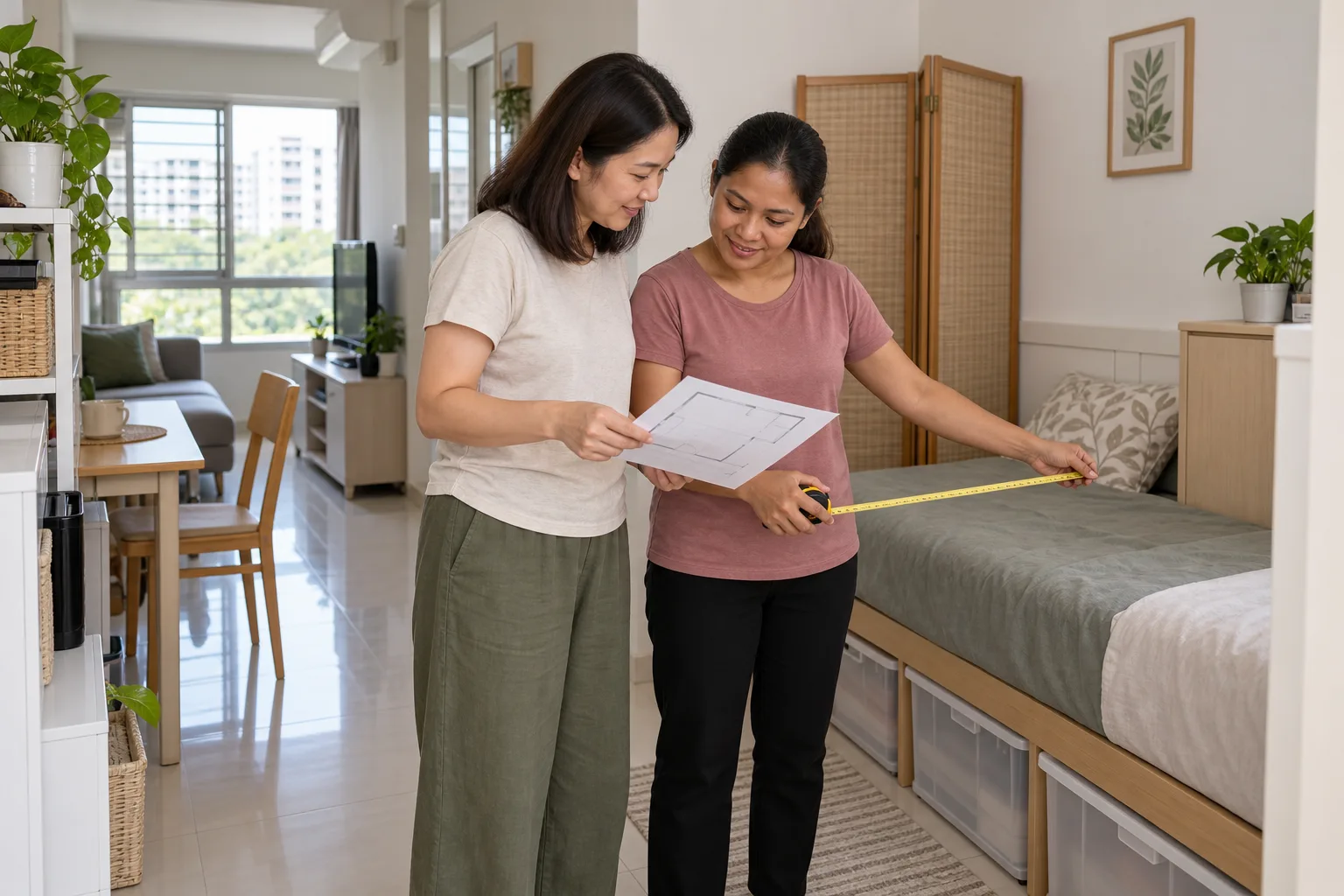
A 2-room HDB flat does not create an automatic right—or an automatic ban—on hiring a migrant domestic worker (MDW). The deciding question is whether MOM accepts the employer’s eligibility and household need, while the employer can provide a safe, dignified home with adequate privacy and sleeping space. Before paying an agency or choosing a candidate, test the home plan as carefully as the application.
Quick answer: MOM considers the household and the space
MOM’s specific 2-room HDB flat eligibility FAQ says that a one-bedroom layout may create a space constraint. MOM will consider the employer’s eligibility and need to employ an MDW. Its employer requirements also make the employer responsible for the helper’s well-being and for providing suitable accommodation. That means household circumstances and the proposed living arrangement both matter.
| Question | Evidence to prepare | Warning sign |
|---|---|---|
| Why is live-in help needed? | Specific childcare, eldercare or household needs | A vague preference with no practical explanation |
| Where will the helper sleep? | A fixed, safe and properly ventilated space | A passageway, unsafe utility area or constantly used living zone |
| How will privacy work? | A door, screen, curtain or other effective boundary | No protection from unwanted intrusion |
| Where are belongings kept? | Dedicated, accessible storage | Sharing cramped storage without consent or security |
| Can rest be protected? | Quiet hours and a realistic household routine | Late-night access through the sleeping area |
| Can the budget carry the role? | Salary, levy, food, insurance, healthcare and contingencies | Planning only for salary and agency fee |
Design the sleeping arrangement before interviewing
Start with the physical layout, not a promise to “work something out later”. MOM’s rest-day and well-being guidance says accommodation must protect the helper from environmental hazards, provide adequate shelter and ventilation, and preserve modesty and privacy. If she shares a room, the person and arrangement must be suitable. Do not place her sleeping area where a male adult or teenager can enter without warning, or where household traffic prevents proper rest.
Measure the proposed bed, walking clearance and storage. Check heat, airflow, light, electrical points, laundry equipment and access to the bathroom. Then discuss the arrangement honestly during the interview. A photo or simple floor plan helps the candidate understand the actual home; her acceptance should be informed, not assumed after arrival.
Match the role to a compact household
A small home may take less time to clean, but care duties can still be intensive. Separate essential work from optional preferences: school runs, medication reminders, mobility assistance, meal preparation, laundry and routine cleaning. Estimate the hours, protect daily rest and weekly rest days, and avoid a schedule that treats the helper as continuously on call merely because everyone shares a small space.
- Write a normal weekday and weekend schedule, including uninterrupted sleep and personal time.
- Explain who lives in the flat, who visits regularly and whether anyone works shifts.
- Agree which cupboards, bathroom storage and charging points are for the helper’s use.
- Set a knock-before-entry rule and a way to change clothes privately.
- Plan how either party can raise a space or privacy concern without embarrassment.
- Revisit the arrangement if a baby arrives, an older person moves in or the household layout changes.
Compare live-in help with lawful alternatives
If adequate sleeping space cannot be created, do not force the live-in model. MOM’s FAQ suggests cleaning services, extended family and childcare or eldercare facilities. The Household Services Scheme lets participating companies provide selected part-time household services. Compare the lawful service scope with your real need; part-time cleaning does not replace full-time personal care, but it may solve a chores-only problem more appropriately.
| Need pattern | Option to assess | Main check |
|---|---|---|
| Several hours of daily personal care | Live-in MDW or formal care service | Eligibility, care skill and viable accommodation |
| Weekly cleaning and laundry | Household Services Scheme provider | Service scope, frequency and total price |
| Supervision during working hours | Childcare, eldercare or day service | Hours, transport and care requirements |
| Short recovery period | Temporary family help or care service | Duration, backup and clinical needs |
| Occasional chores | Cleaning service | Whether live-in employment is disproportionate |
Apply only after the plan is credible
When the arrangement is workable, follow MOM’s MDW Work Permit application process. First-time employers may need the Employers’ Orientation Programme, and all applications still depend on the relevant employer and worker requirements. Keep truthful supporting information ready and let MOM assess the case; an agency cannot guarantee approval.
How this guide avoids overlap
This page owns the narrow search intent “helper in a 2-room HDB flat”: case-by-case assessment, sleeping space and compact-home planning. If household composition is the issue, read whether a single person can hire a helper. For general setup after approval, use the home-onboarding guide. If you only need chores, compare a part-time cleaner with a live-in helper.
Sources and review note
Reviewed on 12 September 2026 against MOM’s 2-room HDB FAQ, employer requirements, well-being guidance, Work Permit process and Household Services Scheme information. Rules and individual outcomes can change; check the linked MOM pages before applying.
Frequently asked questions
Can a family in a 2-room HDB flat hire a domestic helper?
It is not an automatic yes or no. MOM says it will consider the household’s eligibility and need to employ an MDW, while the employer remains responsible for adequate privacy and sleeping space.
Does a domestic helper need her own bedroom in Singapore?
MOM’s published guidance focuses on adequate accommodation, privacy, ventilation, safety and protection from unwanted intrusion. A household should design a genuine sleeping arrangement around those standards, not treat a busy common area or improvised unsafe space as a bed.
What are the alternatives if a live-in arrangement is not workable?
MOM suggests options such as domestic cleaning services, extended-family support and childcare or eldercare facilities. The Household Services Scheme is another lawful route to compare for selected part-time household services.
Official references
These primary references support the guide. A verification date is shown only after a dated editorial review.
- Can a family living in a 2-room HDB flat employ an MDW? — Ministry of Manpower Singapore (checked 12 Sept 2026)
- Employer requirements for hiring a migrant domestic worker — Ministry of Manpower Singapore (checked 12 Sept 2026)
- Rest days and well-being for migrant domestic workers — Ministry of Manpower Singapore (checked 12 Sept 2026)
- Household Services Scheme — Ministry of Manpower Singapore (checked 12 Sept 2026)
- Apply for a Work Permit for a migrant domestic worker — Ministry of Manpower Singapore (checked 12 Sept 2026)
- Parliamentary answer on privacy and accommodation for migrant domestic workers — Ministry of Manpower Singapore (checked 12 Sept 2026)