
Hiring a Domestic Helper as a Single Parent in Singapore
A Singapore single-parent guide to hiring a domestic helper: assess eligibility, interview for your real childcare routine, plan backup and protect rest days.
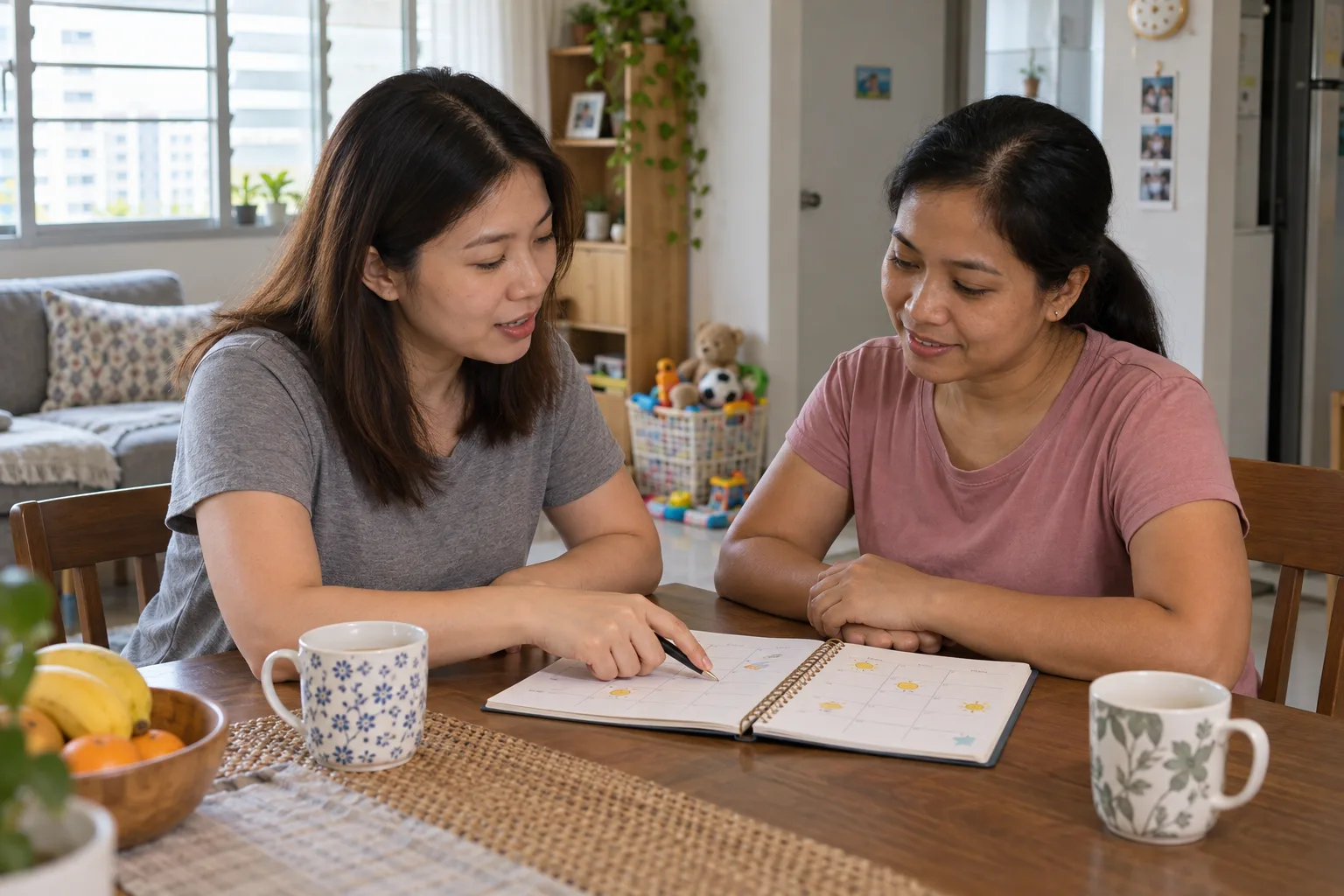
For a single parent, the hard part is often not the ordinary school day but the collision: a child is ill when a work meeting cannot move, or a pickup is late while dinner is due. A live-in domestic helper can support a household routine, yet she cannot replace a parent’s decisions or serve as the only backup. Begin with the exact hours and care tasks you need covered.
Check the application before promising a start date
MOM says it assesses a single person’s eligibility and need to employ a migrant domestic worker (MDW). The applicant must be at least 21, not an undischarged bankrupt and have a steady income to cover salary, levy, insurance and food. MOM also considers caregiving needs and the ability to provide acceptable accommodation. Do not assume that single parenthood either bars or automatically approves an application.
If you are sharing custody or the child stays in more than one home, be explicit about the helper’s declared workplace and the actual care schedule. A helper cannot simply rotate between households or work for another parent. Confirm any proposed arrangement with MOM before relying on it. Decide which adult will be the formal employer, provide accommodation and remain responsible for salary, food, medical care and employment terms.
| Moment | What the helper may support | Parent or backup responsibility |
|---|---|---|
| School morning | Prepare breakfast and agreed school items | Confirm departure and authorised pickup |
| After school | Follow the child’s routine at the declared home | Be reachable for decisions and changes |
| Child becomes ill | Report symptoms and follow established instructions | Decide on medical care and take over as needed |
| Late work meeting | Continue agreed care until a confirmed handover | Arrange another adult if the shift grows |
| Helper’s rest day | No routine childcare duty on the protected day | Provide family or other lawful care |
| Parent emergency | Use a pre-agreed contact chain | Named adult accepts responsibility |
Interview with real handovers, not a generic checklist
Tell candidates the child’s age, school hours, transport needs, meal routine and who else lives in the home. Describe days when you work late or the child spends time with another caregiver. Ask for examples of tasks the candidate actually performed, how long she did them, who supervised and what she would need to learn. Avoid inferring childcare skill from nationality, parenthood or years worked.
- If school pickup is delayed, how would you contact me and keep the child supervised?
- Which child-age groups have you cared for, and what was your exact role?
- How would you handle conflicting instructions from two adults?
- What would you do if the child refused food or felt unwell?
- Which parts of our schedule would be difficult to combine with cooking and cleaning?
- What information would help you feel ready for the first week?
MOM’s eight hiring steps recommend clear instructions and demonstration, not assuming a new helper knows the family’s routines. Interview for calm communication and honest limits. A candidate who says she would ask for clarification can be a stronger fit than one who promises to do everything without support.
Make authority and safety unmistakable
Write down the authorised pickup people, school contact, emergency numbers, transport routes and what information may be shared with another caregiver. Keep custody and family arrangements private except for details genuinely needed for safe handovers. Do not place the helper in the position of deciding a disagreement between adults. You remain responsible for resolving changes in care, permissions and access.
For younger children, walk through the home using HealthHub’s baby home-safety guidance as a starting point. Explain the child’s actual risks and demonstrate each routine. If a child has medical or developmental needs, obtain the appropriate professional plan and train every caregiver on it; a helper’s previous experience is not a substitute for child-specific instruction.
| Disruption | Pre-arranged response | First contact |
|---|---|---|
| Weekly rest day | Parent, relative or lawful childcare arrangement | Named backup adult |
| Helper ill or on leave | Temporary family or service care | Parent |
| Parent late | Confirm a time-limited handover and revised plan | Parent, then backup |
| School closure | Check alternate care and work flexibility in advance | Parent |
| Child emergency | Follow the child’s care instructions and seek urgent help | Emergency services and parent |
| Unexpected overnight need | Arrange another responsible adult | Named family contact |
Protect the helper’s own schedule
MOM’s rest-day and well-being rules require a weekly rest day and at least one rest day per month that cannot be bought out. Give adequate daily rest too. Put mutually agreed terms in the employment contract. A sole parent’s demanding calendar is a reason to design backup care, not to assume continuous availability. Review the real workload privately after the first week and remove lower-priority chores if care takes more time than expected.
How this guide avoids overlap
This guide owns the single-parent care plan: one decision-maker, specific handovers and backup. The single-person eligibility guide covers the application in greater depth. Use the working-parent guide for a broader shortlist, the school-run guide for route safety, and the work-from-home guide for home-office handovers.
Sources and review note
Reviewed on 19 September 2026 against MOM’s single-person eligibility, employer, hiring, contract and rest-day guidance, plus HealthHub home-safety advice. The schedules and questions are editorial examples, not a guarantee of application approval. Verify current requirements and any unusual two-home arrangement directly with MOM.
Frequently asked questions
Can a single parent hire a domestic helper in Singapore?
MOM assesses a single applicant’s eligibility and need individually. Its single-person guidance includes being at least 21, not being an undischarged bankrupt and having a steady source of income. Parenthood alone does not guarantee approval; check your circumstances and current requirements with MOM.
Who cares for my child on the helper’s rest day?
Arrange a named parent, relative, childcare service or other lawful backup before hiring. MOM requires a weekly rest day, including at least one day each month that cannot be compensated away. The helper should not be the sole care plan.
What matters most in a single-parent helper interview?
Use your actual morning, school, illness and late-work scenarios. Ask how the candidate would communicate a delay, prioritise child safety and request backup. Verify relevant experience, then train her on your child’s specific routine rather than assuming past childcare work is identical.
Official references
These primary references support the guide. A verification date is shown only after a dated editorial review.
- Eligibility for a single person to employ an MDW — Ministry of Manpower Singapore (checked 19 Sept 2026)
- Eight steps to hiring a helper — Ministry of Manpower Singapore (checked 19 Sept 2026)
- Making your home safe for your baby — HealthHub Singapore (checked 19 Sept 2026)
- Rest days and well-being for migrant domestic workers — Ministry of Manpower Singapore (checked 19 Sept 2026)
- Contracts and safety agreement for migrant domestic workers — Ministry of Manpower Singapore (checked 19 Sept 2026)
- Employer requirements for hiring a migrant domestic worker — Ministry of Manpower Singapore (checked 19 Sept 2026)