
Domestic Helper for School Runs Singapore: Safety Guide
How employers can assess a helper for school runs, practise safer routes, control authorised handovers, plan delays and protect children on Singapore roads.
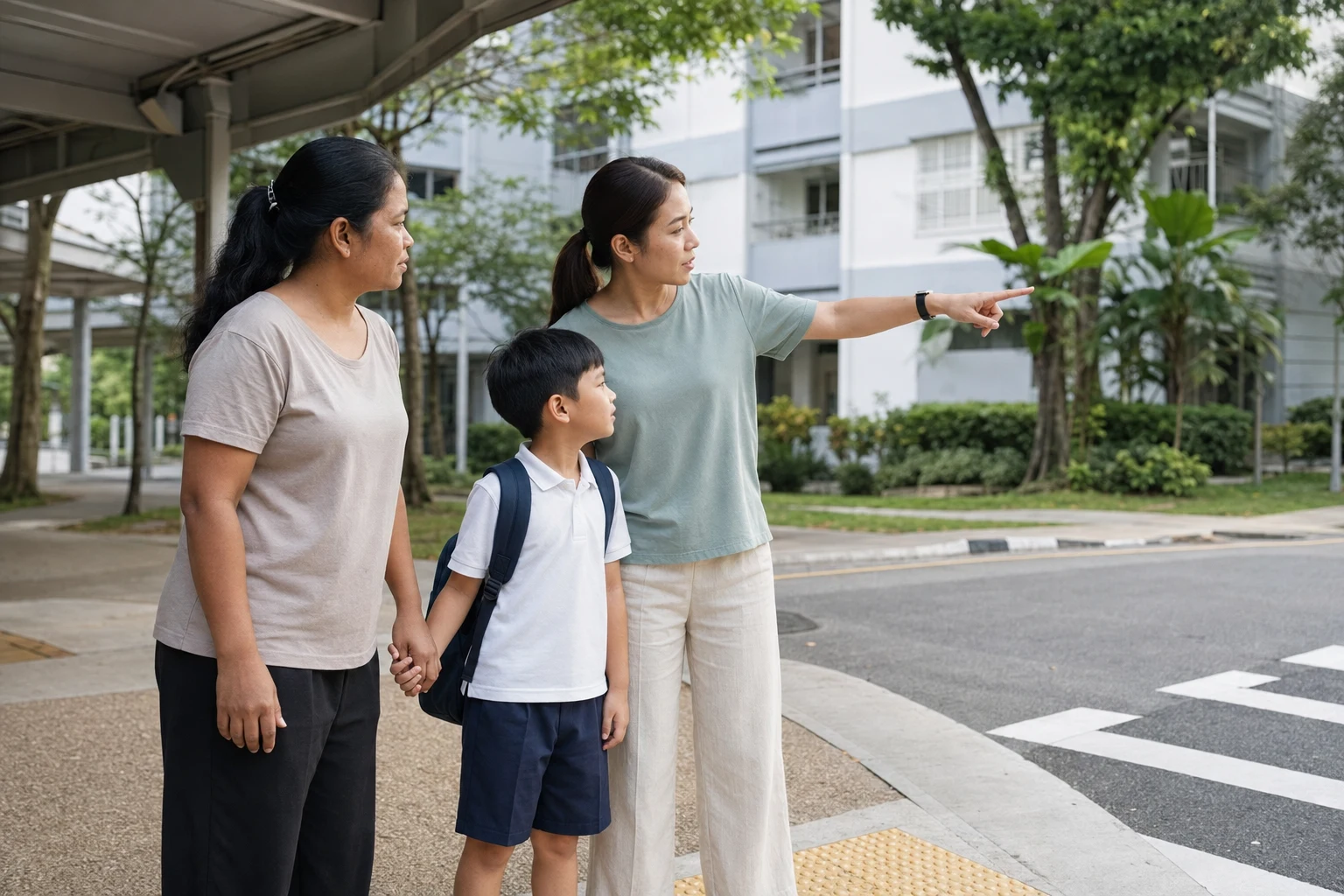
School runs look routine only after the route, handover, and backup have been tested. A domestic helper may be walking with a young child beside traffic, travelling with siblings on public transport, carrying bags in heavy rain, or waiting at a crowded gate while an employer is unreachable. Hire and train for judgement, communication, and safe supervision—not just familiarity with an address.
Quick answer
Before assigning the journey, confirm the school’s authorised pickup process, give written permission where required, and walk the complete route together at the normal time. Define who may receive the child, what the helper does if plans change, and which adult is reachable. Practise road, bus, MRT, taxi, rain, illness, and delay scenarios before the first independent run.
Build a route brief, not a pin on a map
| Area | Document | Practise |
|---|---|---|
| Handover | Gate, time window, authorised adults, ID or pass | Exact release and receipt process |
| Walking | Footpaths, crossings, blind corners, drop-off traffic | Stop points and child position |
| Public transport | Stops, exits, transfers, fares and alternatives | Boarding, seating, alighting and headcounts |
| Weather | Shelter, rain gear, heat, lightning and flooded paths | Delay and alternate-route decision |
| Communication | Reachable parent, school contact and backup adult | Call order and safe place to stop |
| Exception | Late bus, missing child, illness, injury or lost item | Escalation without leaving another child alone |
Verify relevant childcare and travel experience
Browse childcare helper profiles, then ask about the ages and number of children, actual transport modes, length of journeys, school or centre handovers, road crossings, prams, siblings, weather, and employer availability. “Did school runs” is too broad: confirm whether the helper led the journey, accompanied a parent, or used a private school bus with door-to-door handover.
- How did the school confirm you were authorised to collect the child?
- Where did you stand at crossings and on the platform relative to the child?
- How did you count and supervise two or more children while boarding?
- What did you do when a bus was full, a route changed, or rain became unsafe?
- When did you contact the parent, school, transport provider, or emergency services?
- Which part of our proposed route would you want to practise more?
Teach road safety through the actual route
Singapore Police Force pedestrian guidance advises using pedestrian crossings and footpaths, avoiding road bends, obeying crossing signals, and staying off distracting mobile devices while travelling. It also reminds adults to model safe habits and prevent children from crossing between stationary vehicles.
- Choose the safest reasonable route rather than the shortest shortcut.
- Stop before the kerb, scan traffic, and cross only when the route is safe.
- Keep the child on the side away from moving traffic where practicable.
- Do not read messages while walking or crossing; stop in a safe place first.
- Never weave between parked pickup vehicles or call a child across the road.
- Repeat the same rules with the child so the adult and child use one routine.
Interview with school-run scenarios
| Scenario | Ask | Strong answer signals |
|---|---|---|
| Child is not at the agreed gate | What do you do? | Stays at authorised point, contacts school and parent, does not search unpredictably |
| Parent messages while crossing | Do you check now? | Finishes crossing and stops safely before checking |
| A relative asks to take the child | Can you release the child? | Checks authorised list and parent or school process |
| One sibling needs the toilet during pickup | How do you manage both children? | Keeps both supervised and uses planned safe option |
| Transport disruption causes a long delay | Who do you contact? | Updates early, uses agreed alternative, preserves child safety and helper rest |
Control the handover at both ends
Tell the school or childcare centre exactly who may collect the child and follow its current permission and identification process. Give the helper the child’s full name, class, approved contact details, and any pass required, but avoid carrying unnecessary personal documents. At home, define whether the helper must hand the child directly to a named adult or may enter with her own key.
Plan for phones, photos and location sharing
Provide a working phone and transport funds. Use location sharing only with the helper’s knowledge and for a clear safety purpose; do not treat constant surveillance as a substitute for training. Agree when photos may be taken or shared, and never post a child, school pass, route, uniform details, or location publicly. Emergency information should be available without exposing more personal data than necessary.
Run a supervised first-week test
- Day 1: parent leads the full route and school handover while explaining each decision point.
- Day 2: helper leads while parent observes without changing the route unexpectedly.
- Day 3: practise the rain route, missed transport, late pickup and phone-call plan.
- Days 4–5: helper completes the run with a parent available and an immediate debrief.
- End of week: adjust timing, bags, chores, transport budget and backup before routine independence.
Keep the wider job realistic
Count travel, waiting, queueing, and return time as part of the workload. Do not stack cooking deadlines or care for another child so tightly around pickup that the helper must rush. Protect meal breaks and weekly rest days, and name a parent or backup adult for school closures, a sick child, the helper’s illness, transport disruption, and situations involving two children in different places.
How this guide avoids overlap
This page owns route rehearsal, pedestrian safety, authorised school handovers, transport delays, and pickup exceptions. The working-parents childcare guide covers the broader daily role; the shift-work guide covers rotating and overnight parent rosters.
Sources and review note
Last reviewed 3 September 2026. Primary references: Singapore Police Force pedestrian and child-road-safety guidance, HealthHub child-safety material, and MOM contract and rest-day guidance, linked above and listed below. Confirm each school or childcare provider’s current authorised pickup policy directly.
Frequently asked questions
Can a domestic helper take my child to and from school in Singapore?
A helper can handle an agreed school run when the school or childcare centre accepts the authorised pickup arrangement and the family has trained her on the route, road safety, transport, identification, communication, delays, emergencies, and child-specific supervision.
What should I test before assigning a school run?
Walk the complete route together at the actual travel time. Check crossings, bus or MRT changes, lift and gate access, pickup rules, rain alternatives, phone signal, travel time, toilet options, and what happens if the child, helper, vehicle, or parent is delayed.
Should a helper use her phone during the journey?
She needs a charged phone for directions and emergencies, but should stop in a safe place before reading or sending messages. Singapore Police Force guidance advises pedestrians not to be distracted by mobile devices while travelling.
Official references
These primary references support the guide. A verification date is shown only after a dated editorial review.
- Road safety tips for pedestrians — Singapore Police Force (checked 3 Sept 2026)
- Road safety education for children and caregivers — Singapore Police Force (checked 3 Sept 2026)
- Keeping your child safe — HealthHub Singapore (checked 3 Sept 2026)
- Contracts and safety agreement for migrant domestic workers — Ministry of Manpower Singapore (checked 3 Sept 2026)
- Rest days and well-being for migrant domestic workers — Ministry of Manpower Singapore (checked 3 Sept 2026)