
Can a Single Person Hire a Domestic Helper in Singapore?
How MOM assesses a single applicant who wants to hire a domestic helper, including income, caregiving need, documents, accommodation and shortlisting.
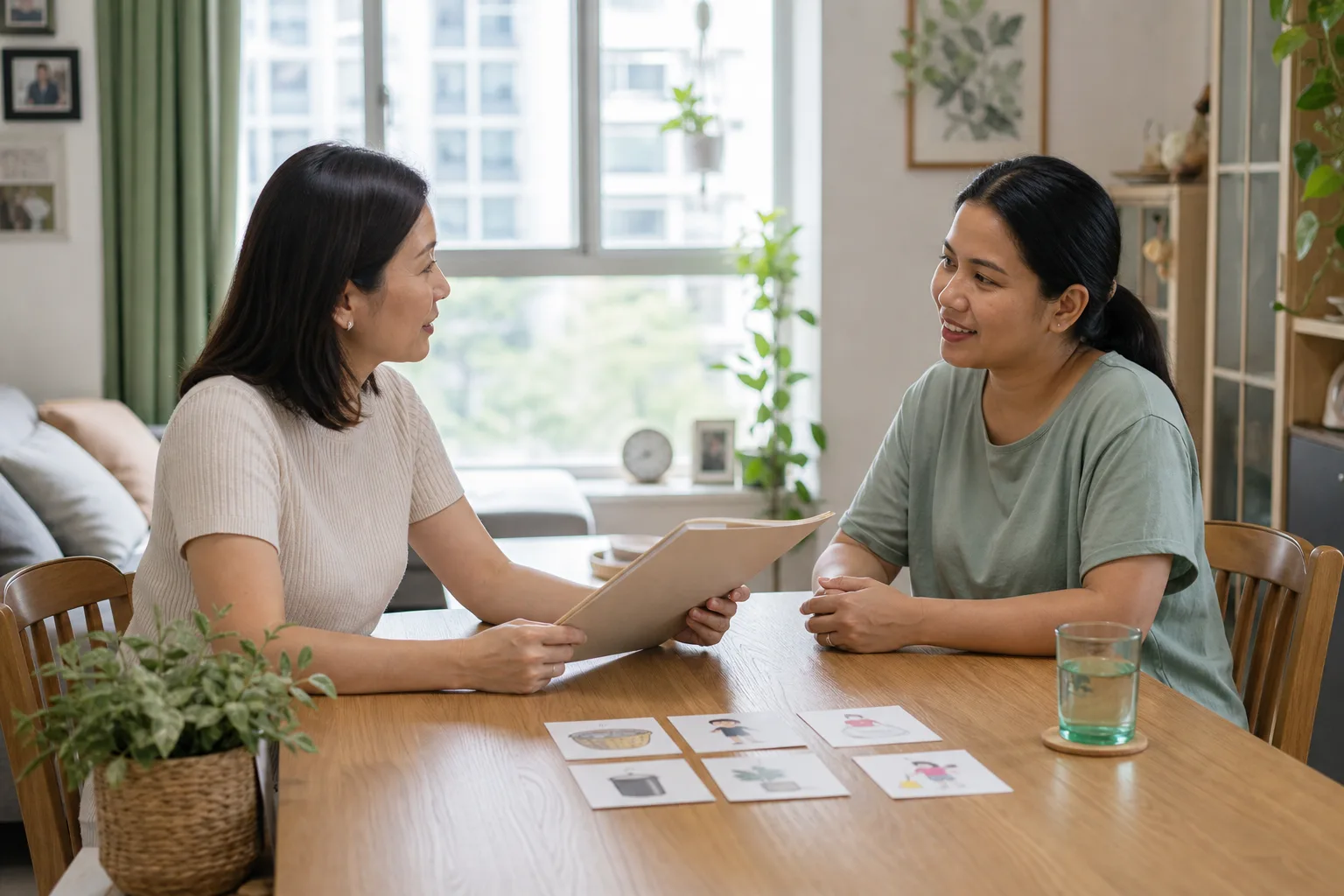
A single adult may need household support for many legitimate reasons: caring for an older parent, living with a disability, managing a demanding work schedule, recovering from illness, or maintaining a home alone. Marital status is not an automatic bar to employing a migrant domestic worker (MDW), but MOM assesses the individual applicant’s eligibility, need, finances and ability to meet employer responsibilities.
Quick answer: single applicants can be assessed
MOM’s single-person eligibility FAQ says an applicant must be at least 21, must not be an undischarged bankrupt, and must earn a steady income. MOM will also assess the person’s need to employ an MDW. Approval is therefore case-specific; paying an application fee or meeting one condition does not guarantee the outcome.
Build the application around four evidence areas
| Assessment area | What to prepare | Planning question |
|---|---|---|
| Basic eligibility | Age, bankruptcy status and capacity to discharge employer duties | Can I personally supervise the employment and make decisions? |
| Household need | Who needs support and which domestic or caregiving tasks are required | Is a live-in helper proportionate to the real need? |
| Financial ability | Steady income and a realistic recurring-cost budget | Can I cover ordinary and unexpected employer expenses? |
| Accommodation | Safe sleeping space, privacy, ventilation and basic amenities | Can my home house another adult properly? |
Do not plan around an unofficial minimum income figure
MOM states that it does not reveal the exact qualifying income amount. The assessment reflects the realistic overall cost of employment, including salary, levy, insurance, food and other expenses. A number quoted in a forum, advertisement or sales conversation should not be presented as MOM’s threshold.
Prepare a monthly budget with a reserve rather than proving only that salary fits. Include levy, food, utilities, medical and personal accident insurance, six-monthly medical checks, healthcare not reimbursed by insurance, rest-day compensation where mutually agreed, agency or administrative fees, household supplies and eventual travel home. A single-income household may have less room to absorb a medical bill or employment change, so the contingency matters.
If your income record is new or overseas
An IRAS Notice of Assessment is not the only possible evidence in every case. MOM says an applicant who has just started working or returned from overseas can provide an employment letter and CPF statements. Follow the current form and any request for additional information; do not submit altered, incomplete or misleading documents.
Describe the need without inflating it
Write a plain task map: household members, the person receiving care, work and travel hours, essential daily duties, weekly chores, nights or emergencies, and tasks that will remain with you or an outside service. This helps MOM understand the household and helps candidates decide whether the position is suitable. A live-in helper should not become a substitute for clinical care, constant awake night duty or an undefined round-the-clock role.
- For an older parent, distinguish companionship and daily living support from nursing procedures.
- For long work hours, identify the actual domestic routine rather than using job seniority as the reason.
- For disability or recovery, list mobility, personal-care and household tasks the candidate has genuinely performed.
- For a small home, test whether part-time household services could meet the need without live-in accommodation.
Check that your home can accommodate another adult
MOM’s general employer requirements include the ability to maintain and upkeep the helper in acceptable accommodation. Plan a safe, ventilated sleeping area with adequate privacy and basic amenities. Explain the arrangement during interviews rather than after acceptance. If space is marginal, ask MOM or a licensed agency about the facts before committing.
Shortlist for a one-employer household
A single employer may be the only person giving instructions, arranging medical care and handling emergencies. Look for relevant task evidence, clear reporting, judgment about when to call, and comfort with the household’s normal quiet periods. Do not choose mainly by nationality, claimed obedience or speed. Give every candidate the same realistic job scope, accommodation facts, rest-day proposal and scenario questions.
| Topic | Ask | Useful evidence |
|---|---|---|
| Independent routine | How did you plan a day when your employer was at work? | Specific sequence, priorities and check-ins |
| Emergencies | What would make you call me immediately? | Clear escalation rather than guessing |
| Core skill | Show or explain the most important care or household task | Recent hands-on experience |
| Communication | How would you raise a workload or safety concern? | Direct, respectful reporting |
| Living arrangement | What questions do you have about the home and privacy? | Informed questions and genuine agreement |
Complete the standard employer steps
First-time employers normally need to complete the Employer Orientation Programme before applying. MOM’s Work Permit application guide then covers written consent, the application, approval, security bond and insurance, arrival, medical examination, permit issuance and other applicable steps. Use the current eService instructions rather than an old checklist.
How this guide avoids overlap
This page owns the single-applicant eligibility, steady-income and evidence intent. For the complete first-hire workflow, use the first-time employer guide; for itemised expenses, use the maid cost guide. Those pages should not be used to invent a guaranteed income threshold for single applicants.
Sources and review note
Last reviewed 5 September 2026. Primary references are MOM’s single-person FAQ, employer and income requirements, alternative income documents, EOP guidance and Work Permit application steps, linked above and listed below. Eligibility decisions remain MOM’s.
Frequently asked questions
Can a single person hire a domestic helper in Singapore?
Yes, a single person may apply. MOM says it will assess the applicant’s eligibility and need. The applicant must be at least 21, must not be an undischarged bankrupt, and must have a steady source of income.
What is the minimum salary for a single person to employ an MDW?
MOM does not publish the exact qualifying income amount. It assesses whether the applicant can realistically meet the helper’s salary, levy, insurance, food and other costs. Do not rely on an agency’s unofficial income threshold as a guarantee of approval.
Can I apply without an IRAS Notice of Assessment?
MOM says a person who has just started work or returned from overseas may provide an employment letter and CPF statements instead. The documents required for a particular application can vary, so check the current application instructions before submission.
Official references
These primary references support the guide. A verification date is shown only after a dated editorial review.
- Eligibility for a single person to employ an MDW — Ministry of Manpower Singapore (checked 5 Sept 2026)
- How MOM assesses income for employing an MDW — Ministry of Manpower Singapore (checked 5 Sept 2026)
- Documents for an MDW application without an IRAS Notice of Assessment — Ministry of Manpower Singapore (checked 5 Sept 2026)
- Employer requirements for hiring a migrant domestic worker — Ministry of Manpower Singapore (checked 5 Sept 2026)
- Employers Orientation Programme requirements — Ministry of Manpower Singapore (checked 5 Sept 2026)
- Apply for a Work Permit for a migrant domestic worker — Ministry of Manpower Singapore (checked 5 Sept 2026)