
Can a Domestic Helper Work at Your Parents’ Home in Singapore?
When an MDW may care for your child or parent at a relative’s home, including MOM notification rules, work limits, consent, accommodation and alternatives.
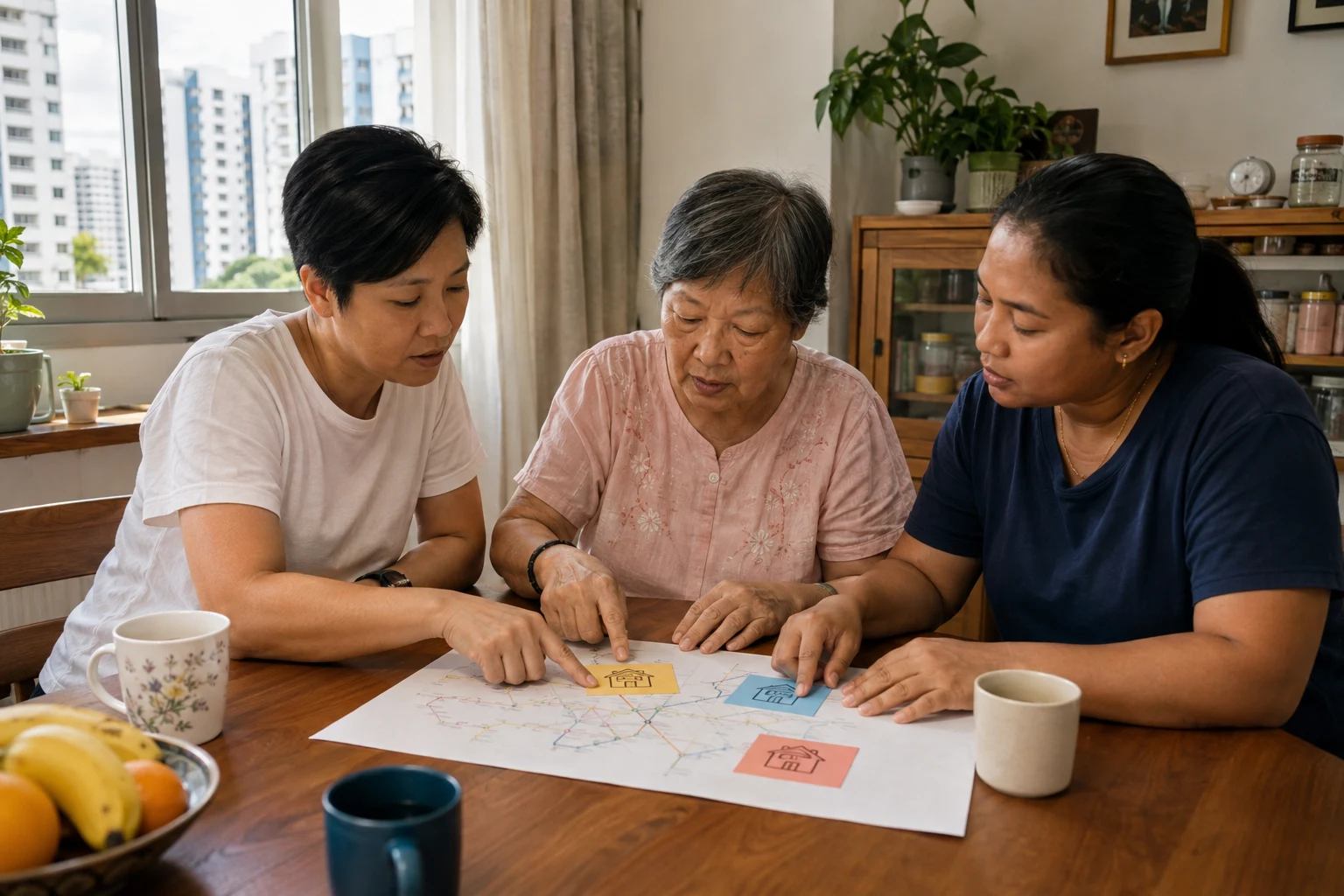
A common Singapore arrangement is for a domestic helper to bring a child to grandparents’ home or help an older parent who lives with another relative. The arrangement is not automatically the same as ordinary work at the employer’s declared address. Before scheduling it, identify whose care is involved, who the official employer is, where the helper will work or sleep, and whether the plan meets MOM’s notification conditions.
Quick answer
MOM says an MDW may take care of her employer’s child or parent at a relative’s house only after the employer notifies MOM and meets the stated conditions. First obtain the helper’s written agreement, ensure she is not doing the full housework load in both households, and provide compliant accommodation if an overnight stay is required. If the real purpose is to hire a helper to work for a relative, that relative should be the official employer.
Separate two arrangements that look similar
| Question | Permitted care arrangement | Proxy-employment warning |
|---|---|---|
| Who needs care? | Employer’s child or parent | Another relative or household generally needs its own employer arrangement |
| Why visit the second home? | To provide the notified care | To supply regular labour to a different household |
| Housework scope | Limited and connected to the care arrangement | Full cleaning and chores for both homes |
| Employer control | Official employer remains responsible and contactable | Relative effectively directs employment and employer is only a name on paper |
| MOM step | Notify MOM before proceeding | Relative should check employer eligibility or special schemes |
MOM’s separate FAQ states that an MDW cannot be hired in one person’s name and simply sent to work for a relative. The rule is intended to prevent one worker from being exploited across multiple employers and households.
Complete the MOM conditions before the arrangement starts
- Describe the care recipient, relative’s address, normal schedule, transport, duties, and whether overnight stays are planned.
- Discuss the arrangement with the helper in language she understands and obtain her written agreement.
- Remove the expectation that she will carry the full domestic workload in both households.
- Check bedroom, privacy, ventilation, safety, food, bathroom access, and personal storage if she will stay overnight.
- Submit the required MOM notification and keep the acknowledgement with the household records.
- Notify MOM again before proceeding if the arrangement materially changes.
Use MOM’s current notification page and FDW eService route rather than relying on an old message, agency shortcut, or verbal understanding. Keep a dated copy of what was agreed and submitted.
Write a one-care-role job scope
A care arrangement should not quietly become two full jobs. List the tasks directly connected to the child or parent: supervision, meals for the care recipient, personal care, mobility support, school or clinic transport, laundry related to care, and a reasonable cleanup of the spaces used. Decide which general chores remain at the employer’s home and which chores the relative’s household will handle itself.
| Scenario | Ask | Safe planning signal |
|---|---|---|
| Grandparent requests whole-flat cleaning | Is this part of the notified care role? | Employer resets scope and relative keeps their household workload |
| Child stays late unexpectedly | Who approves and who covers transport? | One named employer contact and agreed fallback |
| Helper is told to sleep in the living room | Does accommodation meet MOM requirements? | Private, safe, ventilated and properly equipped arrangement |
| Instructions from two homes conflict | Whose direction takes priority? | Official employer resolves conflict directly |
| Care needs increase | Is current training and staffing still adequate? | Review duties, training, services and notification before continuing |
Shortlist for the real care and travel routine
If the arrangement is mainly for an older parent, start with elderly-care helper profiles and verify the exact personal-care, mobility, meal, medication-reminder, appointment, and communication experience. For a child, verify the child’s age, school or childcare route, supervision needs, and handover experience. A candidate also needs to understand that she will travel between two familiar homes without becoming responsible for both households.
Protect consent, privacy and a way to raise problems
Written agreement should be meaningful, not a signature obtained after the plan is fixed. Explain address, travel time, duties, household members, cameras, sleeping arrangements, rest, food, and how the helper can contact the employer privately. Tell the relative that the helper may report workload, safety, treatment, or accommodation concerns directly and that retaliation is unacceptable.
Plan transport, records and handovers
- Practise the route during normal travel hours and fund required transport.
- Give the helper both addresses, household contacts, emergency numbers, and a charged phone.
- Use one care record rather than separate, conflicting instructions from relatives.
- Keep identity, medical, school, financial, and family information private and securely stored.
- Agree arrival, departure, meal, rest, and employer check-in times.
- Create a backup for the helper’s weekly rest day, illness, training, and home leave.
Consider alternatives when the structure is wrong
If the relative needs a full-time helper for their own household, explore having the relative become the employer, subject to MOM eligibility. Other possibilities may include joint income or sponsorship schemes, home personal care, home nursing, senior services, childcare, transport, meal delivery, or Household Services Scheme providers for eligible task types. Match the service to the need instead of stretching one Work Permit across two households.
How this guide avoids overlap
This page owns the relative’s-address notification, consent, overnight accommodation, and two-household workload intent. For general ongoing senior-care shortlisting, use the elderly-care helper guide; for temporary professional support after discharge, use the post-hospital-discharge guide.
Sources and review note
Last reviewed 3 September 2026. Primary references: MOM’s FAQs on care at a relative’s home and proxy employment, notification guidance, employment rules, contract guidance, and rest-day requirements, linked above and listed below. Confirm the current facts of your arrangement directly with MOM before proceeding.
Frequently asked questions
Can my domestic helper care for my parent at my parent’s home?
MOM says an MDW normally works at the declared residential address, but an employer may arrange care for their child or parent at a relative’s house after notifying MOM, obtaining the helper’s written agreement, avoiding a full housework load in both homes, and meeting accommodation rules if she stays overnight.
Can I hire a helper in my name just to work for a relative?
No. MOM says the relative should be the official employer when the helper is really being hired to work for that relative. Special schemes such as joint income or sponsorship may be relevant in some households, but eligibility should be checked directly with MOM.
Who remains responsible for the helper at the relative’s home?
The official employer remains responsible for the helper’s salary, levy, upkeep, acceptable accommodation, adequate food, medical care, well-being, rest, and compliance with Work Permit conditions. A relative giving day-to-day care instructions does not replace the employer’s legal responsibility.
Official references
These primary references support the guide. A verification date is shown only after a dated editorial review.
- When an MDW may care for a child or parent at a relative’s house — Ministry of Manpower Singapore (checked 3 Sept 2026)
- Why an MDW cannot be hired to work for a relative — Ministry of Manpower Singapore (checked 3 Sept 2026)
- Notify MOM of changes during an MDW’s employment — Ministry of Manpower Singapore (checked 3 Sept 2026)
- Employment rules for migrant domestic workers — Ministry of Manpower Singapore (checked 3 Sept 2026)
- Contracts and safety agreement for migrant domestic workers — Ministry of Manpower Singapore (checked 3 Sept 2026)
- Rest days and well-being for migrant domestic workers — Ministry of Manpower Singapore (checked 3 Sept 2026)