
Hire a Domestic Helper in a Rented Home: Singapore Guide
Can tenants hire a helper in Singapore? Plan residence proof, landlord discussions, sleeping space, declared address and future moves before applying.
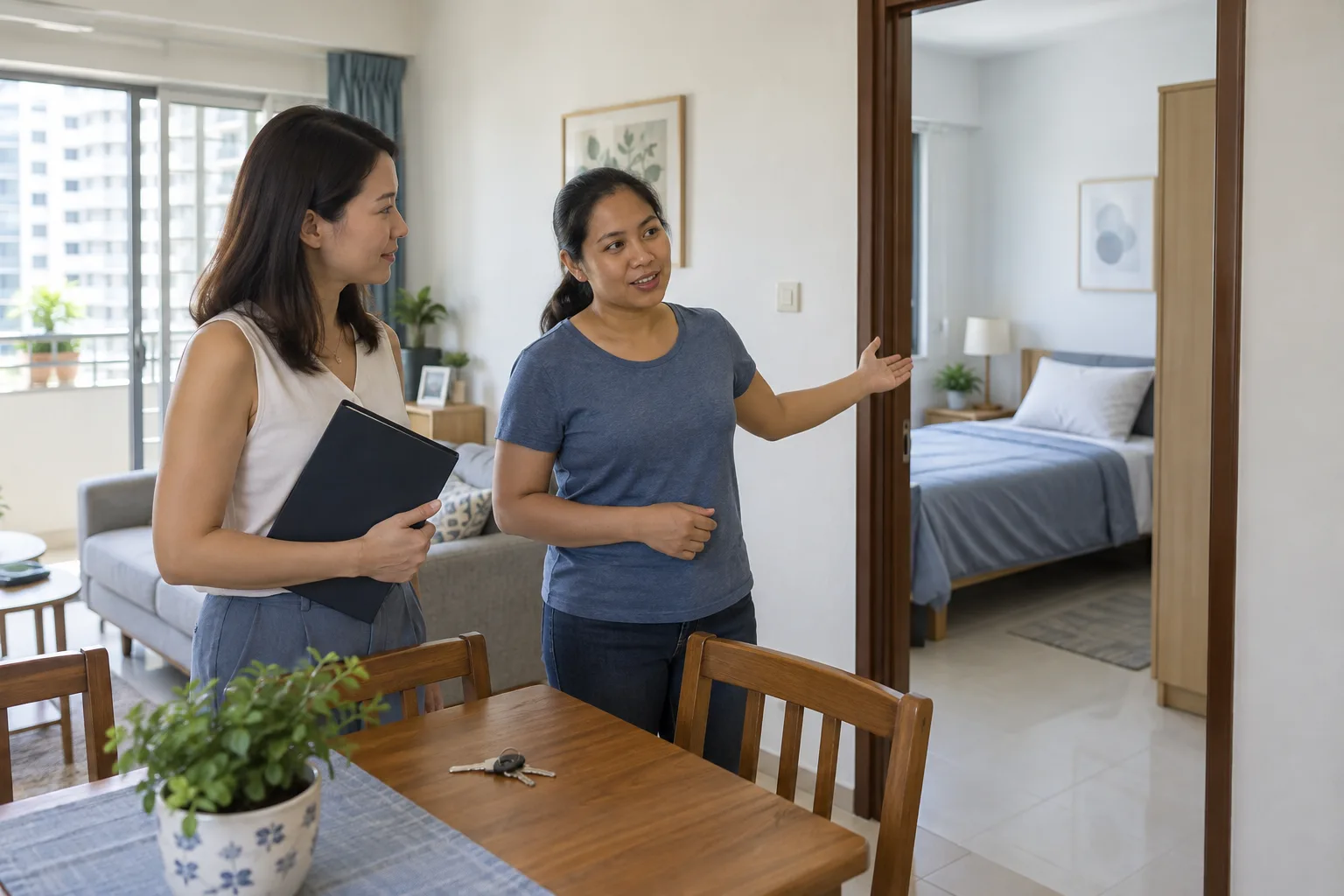
A tenant can have the same caregiving or household needs as a homeowner, but the home is governed by both employment rules and a tenancy. Before you shortlist a helper, confirm that you can document your stay, lawfully accommodate another household member and preserve a suitable sleeping space for the likely term of employment. A Work Permit application should not be the first time the landlord learns about the plan.
Start with residence proof and employer eligibility
MOM’s temporary-residence FAQ says you can apply for an MDW while staying at a temporary residence. You must provide proof of stay, such as your NRIC and tenancy agreement, and inform MOM of the new residential address after you move. This supports an application from a rented or temporary home, but it is not a guarantee that every applicant or property arrangement will be approved.
You must also meet MOM’s employer requirements. MOM considers eligibility, caregiving needs, financial ability and the ability to maintain and upkeep the helper in acceptable accommodation. First-time employers must complete the Employers’ Orientation Programme before applying. Renting does not reduce those responsibilities.
| Check | Evidence or decision | Resolve before hiring |
|---|---|---|
| Your residence | Current address and proof of stay | Tenancy dates match the intended start |
| Household occupancy | Who is authorised to live in the unit | Discuss the helper with owner or agent |
| Sleeping space | Actual room or private area shown to the candidate | Ventilation, safety, amenities and privacy |
| Workplace address | Address that will be declared to MOM | No informal second work site |
| Lease end | Renewal or likely next-home plan | Contingency before the tenancy expires |
| House rules | Property access, keys and facilities | Helper can use the home safely and reasonably |
Read the tenancy agreement as well as MOM rules
Check clauses on permitted occupants, subletting, access cards, alterations and landlord inspections. A live-in helper is an employee and household member, not a substitute tenant, but the property owner may still need accurate occupancy information or building access registration. Ask the landlord or agent for a written answer where the lease is unclear. Do not promise the helper a start date while a material housing disagreement remains unresolved.
If you rent only a room rather than the whole home, suitability is more complex. Ask who controls common areas, who else lives there, whether the helper has lawful and practical use of the kitchen and bathroom, and whether any sleeping proposal meets privacy and modesty requirements. Confirm an unusual arrangement with MOM before applying instead of relying on an agent’s casual assurance.
Show the real accommodation during recruitment
MOM’s rest-day, accommodation and well-being guidance requires shelter, basic amenities, sufficient ventilation, safety, modesty, space and privacy. Employers should provide a separate room; if that is not possible, adequate space and privacy are still required. These duties apply even when the landlord owns the furniture or limits changes to the room.
Give candidates a video or in-person tour that shows the proposed bed, storage, windows or fan, bathroom route and shared spaces. Explain the tenancy end date and any likely move. Do not photograph a spare room if the plan is to use that room as an office or guest room after the helper arrives. If a landlord inspection is scheduled, provide reasonable notice and protect the helper’s personal belongings and changing privacy.
- Is the proposed sleeping space available every night?
- Can the helper access the kitchen, bathroom and laundry facilities?
- Who else has keys or authority to enter the unit?
- Are there cameras or building access systems to disclose?
- What happens if the landlord sells the unit or does not renew?
- Will the family move during the expected employment period?
Keep work at the declared residential address
Under MOM’s MDW employment rules, a helper may work only for her employer at the residential address declared to MOM and may perform only domestic chores. Renting a second room, keeping a previous flat or spending weekends elsewhere does not create an automatic second workplace. Ask MOM about any exceptional care arrangement before using it.
| Event | Employer action | Helper discussion |
|---|---|---|
| Lease renewed | Keep proof and confirm household terms | Explain any room or access change |
| Moving to a new rental | Update the address through the required route | Show and assess new accommodation first |
| Temporary gap between homes | Confirm the proposed address with MOM | Agree where she will live and work |
| Landlord needs access | Give notice and supervise appropriately | Protect privacy and belongings |
| Owner objects to occupancy | Resolve legally before the start or move | Do not place the helper in the dispute |
| Tenancy ends unexpectedly | Arrange suitable housing and update MOM promptly | Provide a clear, safe transition |
MOM’s notification page for MDW changes says employers must update a new residential address within two weeks using the route for their status. The helper’s workplace address is then updated. Plan the move, sleeping space and travel routine before the change, not after furniture has already been packed.
How this guide avoids overlap
This guide owns tenant-specific planning: proof of stay, lease discussions and housing continuity. The moving-house guide covers the move itself, the sleeping-arrangement guide examines accommodation standards in depth, and the renovation guide addresses a temporary building-site disruption.
Sources and review note
Reviewed on 24 September 2026 against MOM’s temporary-residence, employer, accommodation, employment and address-notification guidance. Lease interpretation and property approvals depend on the actual agreement and premises; obtain advice from the landlord, relevant authority or a lawyer where needed.
Frequently asked questions
Can I hire a domestic helper if I rent my home in Singapore?
Renting does not by itself prevent an application. MOM says an applicant at a temporary residence can apply with proof of stay, such as the NRIC and tenancy agreement, and must inform MOM after moving. You must still meet employer criteria and provide acceptable accommodation at the declared residence.
Do I need my landlord’s permission to house a helper?
MOM’s temporary-residence FAQ focuses on proof of stay, not private tenancy permission. Review your tenancy agreement and discuss the intended household occupancy with the owner or agent before hiring. Resolve any property-specific approval or occupancy issue rather than assuming the Work Permit overrides the lease.
What happens if I move during the helper’s employment?
Update the relevant residential address through the route MOM specifies. MOM says a new residential address must be updated within two weeks, after which the helper’s workplace address is updated. Plan suitable accommodation at the new home before committing to the move.
Official references
These primary references support the guide. A verification date is shown only after a dated editorial review.
- Applying for an MDW while living at a temporary residence — Ministry of Manpower Singapore (checked 24 Sept 2026)
- Employer requirements for hiring a migrant domestic worker — Ministry of Manpower Singapore (checked 24 Sept 2026)
- Rest days and well-being for migrant domestic workers — Ministry of Manpower Singapore (checked 24 Sept 2026)
- Employment rules for migrant domestic workers — Ministry of Manpower Singapore (checked 24 Sept 2026)
- Notify MOM of changes during an MDW’s employment — Ministry of Manpower Singapore (checked 24 Sept 2026)