
Domestic Helper Fire Safety: Singapore Home Checklist
Create a fire-safety plan with your helper: prevent hazards, test alarms, map evacuation, protect vulnerable family members and practise 995 calls.
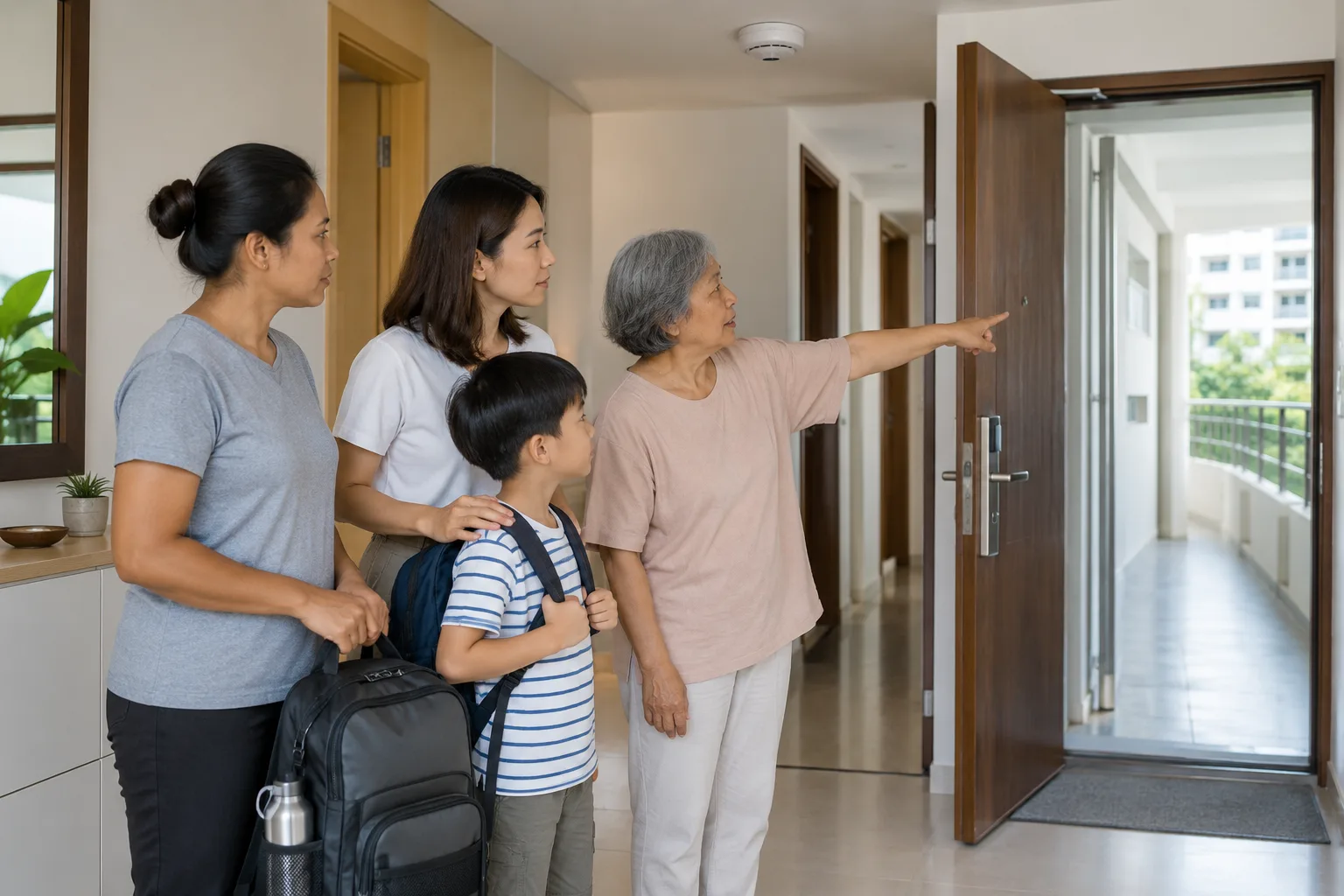
A fire plan is a whole-household responsibility. A domestic helper may spend long periods at home and may be the adult present with a child, older person or pet, but that does not make her the household’s default firefighter or sole rescuer. Employers should remove hazards, provide working equipment, teach a simple response and practise it with everyone who lives in the home.
Start with hazards, not a rescue script
Use SCDF’s Home Fire Safety Checker together. Its ten-question assessment is designed to identify common risks and provide tailored recommendations. Walk through the actual kitchen, charging points, corridor and bedrooms rather than handing the helper a rule sheet she has never seen applied.
| Area | Check together | Employer action |
|---|---|---|
| Kitchen | No unattended cooking; combustibles away from heat | Provide safe cookware and explain gas or power shut-off |
| Sockets and cables | No overloading, exposed wiring or damaged plugs | Replace unsafe equipment; do not ask the helper to repair it |
| Device charging | No damaged batteries or prolonged unattended charging | Set a safe charging location and routine |
| Exit route | Door, corridor and stairs remain clear | Remove storage that blocks escape |
| Alarm | Everyone recognises the sound and knows the next step | Install and maintain suitable detection |
| Vulnerable person | Mobility, hearing, vision and medication needs are known | Create an individual assistance plan |
SCDF explains that a Home Fire Alarm Device gives early warning and recommends smoke detection for primary home protection. New homes and certain homes undergoing fire-safety works are subject to installation requirements; existing homeowners are also encouraged to install a device. Follow the manufacturer’s maintenance instructions and make alarm testing part of the household routine.
Teach one clear response sequence
SCDF’s Civil Defence Emergency Handbook is the primary reference for household emergency skills. A practical script is: alert others, leave when the fire cannot be handled safely, call 995 and activate the nearest alarm. Nobody should delay escape to collect belongings, film the incident or fight a growing fire.
- Say the full address, block, floor and unit during the 995 call.
- State if a child, older person or person with a disability needs assistance.
- Close doors when doing so does not delay safe evacuation.
- Use the agreed outdoor meeting point and count household members.
- Never re-enter for a person, pet or item; update responders instead.
- Follow SCDF instructions when the real situation differs from the drill.
For high-rise homes, SCDF’s high-rise fire guidance says not to use lifts during a fire; evacuate by exit stairs. In a super high-rise building, a refuge floor can serve as a temporary safe holding area. Walk the route in normal conditions and point out stair doors, alarms and refuge-floor signage where applicable.
Make a separate plan for mobility or sensory needs
A person who cannot use stairs changes the plan. Record the safest waiting location for your building, the person’s exact limitations and who can assist without unsafe lifting. SCDF advises calling 995 with the exact location and telling the dispatcher that mobility assistance is required. Identify nearby family or neighbours who have agreed to help, but do not rely on one helper improvising a carry through smoke.
| Role | Primary person | Backup |
|---|---|---|
| Alert household | Adult who discovers danger | Any person who hears the warning |
| Call 995 | Adult with a working phone | Second adult or neighbour |
| Guide a child | Named adult | Second named adult |
| Support mobility plan | Trained and physically able adult | Family, neighbour or SCDF response |
| Take Ready Bag | Only if immediately accessible | Leave it; life comes first |
| Meet responders | Safe adult outside | Give location by phone |
Keep an accessible Ready Bag
SCDF’s Ready Bag guidance lists a torch with batteries stored separately, essential medication, document copies in a waterproof folder, a whistle, first-aid kit, special-care items and an N95 mask among core items. It recommends keeping the bag accessible even in darkness and checking expiring supplies. The bag supports evacuation; nobody should retrieve it if doing so is unsafe.
Run a short drill after onboarding
Within the helper’s first week, demonstrate the alarm sound, exits, meeting point, 995 call and individual care plan. Ask her to explain the sequence back in her preferred language. Repeat after a move, renovation, mobility change or new appliance. A calm five-minute walk-through every few months is more useful than a long policy nobody remembers.
Use the window-cleaning safety guide for MOM’s restrictions on high-rise cleaning and the landed-property guide for workload and grounds-specific risks. Fire prevention and evacuation remain shared employer duties, not additional unpaid expertise assumed from a helper.
How this guide avoids overlap
This guide owns home fire prevention, alarms, evacuation roles, Ready Bags and drills. The window-cleaning article owns MOM’s exterior-window restrictions; the landed-home article owns property-size workload and task safety. This is not a general housekeeping checklist.
Sources and review note
Reviewed on 1 October 2026 against current SCDF home-fire, high-rise evacuation, alarm-device, emergency-handbook and Ready Bag guidance. Use your building’s current fire plan and follow SCDF instructions during an actual emergency.
Frequently asked questions
What should a domestic helper do if there is a fire at home?
Use the household plan: alert everyone, leave when it is unsafe to fight the fire, call 995 with the exact address and activate the nearest fire alarm. SCDF says not to use lifts during a high-rise fire; use exit stairs. Firefighting should be attempted only when it can be done without endangering anyone.
Should a helper be responsible for carrying an elderly person during a fire?
Do not make an untrained helper solely responsible for a dangerous carry. Build a plan around the person’s mobility, exit route, neighbours or family who can assist and an early 995 call that states the exact unit and mobility limitation. Follow current SCDF guidance for elderly people and persons with disabilities.
What should be in a Singapore household Ready Bag?
SCDF lists items including a torch and separate batteries, essential medication, copies of important documents in a waterproof folder, a whistle, first-aid supplies, special-care items and an N95 mask. Keep the bag accessible, tell every household member where it is and review expiring items.
Official references
These primary references support the guide. A verification date is shown only after a dated editorial review.
- Home Fire Safety Checker — Singapore Civil Defence Force (checked 1 Oct 2026)
- Home Fire Alarm Device guidance — Singapore Civil Defence Force (checked 1 Oct 2026)
- Civil Defence Emergency Handbook — Singapore Civil Defence Force (checked 1 Oct 2026)
- Fire outbreak in a high-rise building — Singapore Civil Defence Force (checked 1 Oct 2026)
- Ready Bag for emergencies — Singapore Civil Defence Force (checked 1 Oct 2026)
- How to ensure your helper works safely — Ministry of Manpower Singapore (checked 1 Oct 2026)