
Second Domestic Helper Singapore: Eligibility and Cost Guide
Can your household hire a second domestic helper in Singapore? Check MOM eligibility, levy treatment, space, costs, duties, and application evidence.
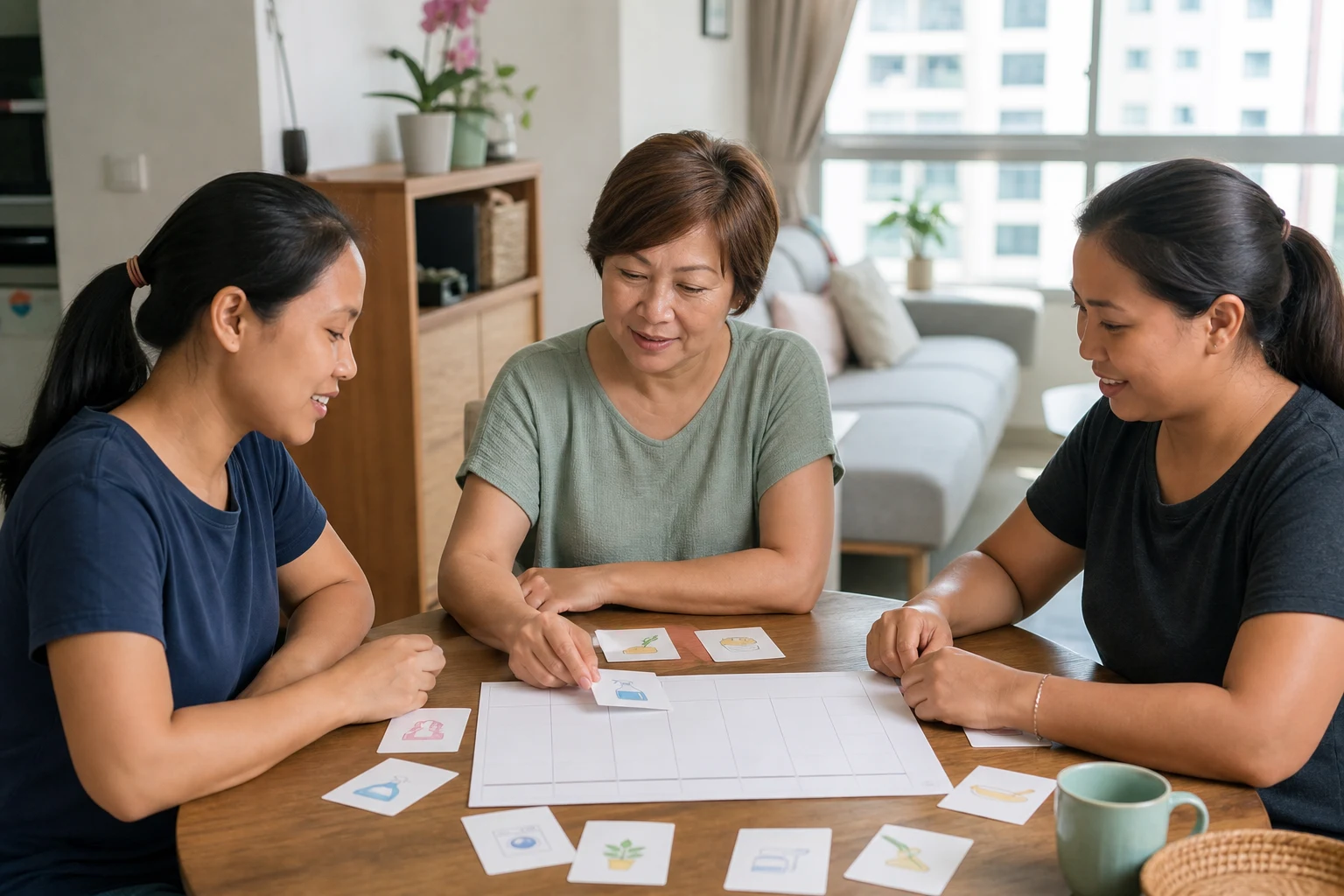
Hiring a second domestic helper in Singapore can make sense when one person cannot safely cover simultaneous childcare, eldercare, disability support, cooking, and household work. It is not simply a second copy of the first role. MOM assesses whether the household meets a recognised care criterion, can afford both helpers, and can provide adequate privacy and sleeping space.
Quick answer
A household may qualify for a second migrant domestic worker (MDW) if it meets one of MOM's listed care-related criteria. Approval is not automatic. Read the current MOM second-helper eligibility rules, calculate the full cost of two separate employments, define non-overlapping roles, and confirm that both helpers will have acceptable accommodation, rest, and a clear reporting arrangement.
MOM eligibility for a second helper
| Household situation | Evidence to prepare | Planning question |
|---|---|---|
| Employer or spouse is at least 60 | Identity details requested in the application | What daily assistance is actually needed? |
| At least 2 children below 18 live in the home | Children's birth certificates | Which duties happen at the same time? |
| Parent or parent-in-law aged at least 60 lives in the home | Identity cards and documents showing the relationship | Who covers personal care, appointments, and nights? |
| Resident family member qualifies as a person with disabilities | Relevant AIC assessment documentation | Which tasks require trained care or family oversight? |
MOM also considers your financial ability to hire, maintain, and upkeep both helpers. The home must offer sufficient privacy and sleeping space. Meeting one family criterion starts the assessment; it does not remove these other responsibilities.
Budget for two complete employment relationships
The second MDW has her own salary, levy, insurance, medical obligations, Work Permit administration, travel or placement costs, meals, accommodation needs, and repatriation responsibility. MOM's current MDW levy page lists a normal monthly rate of $300 for the first helper, $450 for subsequent helpers, and $60 at the concessionary rate.
| Item | Second-helper implication | Official point to verify |
|---|---|---|
| Monthly levy | The subsequent-helper rate may apply unless a second concession is approved | Current MOM levy bill and concession status |
| Salary and agreed rest-day compensation | A separate written package for each helper | Salary payment records and rest-day agreement |
| Medical and personal accident insurance | A compliant policy is needed for each helper | Coverage limits and effective dates |
| $5,000 security bond | Required for each non-Malaysian helper | Bond transmitted before arrival |
| Agency, travel, medical, and setup costs | Usually incurred again | Itemised quotation and refund or replacement terms |
| Food, utilities, and accommodation | Ongoing household cost and space increase | A realistic monthly household budget |
A levy concession for the first helper does not automatically extend to the second. MOM says one helper can receive concessionary treatment per eligible person; two eligible persons are required for a second concession. Check the current levy-concession criteria rather than assuming the rate.
Decide whether the workload really requires two helpers
Write a seven-day workload map before searching. Mark school runs, infant feeds, elder appointments, personal care, meal preparation, cleaning, overnight needs, and the times a family member is present. The strongest case for a second helper is usually simultaneous work that cannot be safely postponed—not a general wish for every task to be completed faster.
- Two care recipients need attention in different places at the same time.
- One role requires focused infant, dementia, mobility, or disability support while routine household work continues.
- Night-time care regularly affects the next day's safe workload and a sustainable rotation is possible.
- The household can provide two lawful, fair roles without treating either helper as permanently on call.
- Family members remain able to supervise care plans, emergencies, medical decisions, and employment responsibilities.
Give each helper a primary role without creating a hierarchy
Define primary ownership—for example, infant routine and meal preparation for one helper, eldercare support and laundry for the other—plus a short list of shared duties. Avoid vague instructions that one helper must “manage” the other unless that arrangement was disclosed and accepted. The employer remains responsible for directions, workload, conflict resolution, salary, safety, and well-being.
- Give both helpers written daily and weekly responsibilities.
- Name which family member makes final decisions when instructions conflict.
- Plan fair access to food, the bathroom, storage, phone time, and privacy.
- Schedule individual check-ins so concerns can be raised without pressure.
- Create a handover method for care notes without sharing private employment matters.
- Review workload after two weeks and again after the first month.
Accommodation and rest need deliberate planning
Two helpers need suitable sleeping arrangements and reasonable privacy; a busy care plan does not remove rest-day requirements. MOM states that an MDW is entitled to one rest day per week, with at least one rest day each month that cannot be compensated away. Use the current MOM rest-day and well-being guidance to plan coverage fairly.
How to shortlist for complementary fit
Start with your two role briefs, then search current maid biodata for the experience each role requires. Do not shortlist solely by nationality or years worked. Compare verified duties, communication, care skills, availability, expected salary, and willingness to work in a two-helper household.
- Have you worked with another helper, nurse, or family caregiver? How were duties divided?
- Which tasks do you prefer to own, and which require training?
- How would you handle conflicting instructions from another helper and an employer?
- What information must be handed over at the end of a care shift?
- What sleeping, rest-day, phone-use, and privacy arrangements do you expect?
- What would make the role feel unfair or unsafe to you?
Application checklist
- Confirm that your household meets at least one MOM second-helper criterion.
- Prepare the children's, parent's, relationship, or AIC documents relevant to your case.
- Build a two-helper budget using the correct levy assumptions.
- Check that the sleeping arrangement offers sufficient space and privacy.
- Submit a separate Work Permit application and pay the applicable fees.
- Arrange the required bond and insurance for the incoming helper.
- Agree each role, salary, rest days, accommodation, and start plan in writing.
Follow MOM's Work Permit application steps. If your need is temporary or mostly task-based, compare the Household Services Scheme before committing to a second live-in employment.
How this guide avoids overlap
This page owns the “second domestic helper Singapore” eligibility and two-helper household-planning intent. For a general first hire, use the step-by-step Singapore hiring guide. For a complete one-helper cost model, use the 2026 maid cost guide.
Sources and review note
Last reviewed 27 August 2026. Primary references: MOM rules for a second MDW, Work Permit applications, levy and concession rates, security bonds, insurance, and rest-day obligations linked above.
Frequently asked questions
Who can hire a second domestic helper in Singapore?
MOM says a household may be eligible when the employer or spouse is at least 60, there are at least two children below 18 living in the home, a parent or parent-in-law aged at least 60 lives there, or a resident family member has an AIC assessment qualifying as a person with disabilities. MOM also considers finances, privacy, and sleeping space.
How many domestic helpers can one household employ?
MOM states that each household can hire up to two migrant domestic workers. Approval for the second helper is still subject to the eligibility and household assessment.
Does the second helper automatically receive the concessionary levy?
No. MOM says levy concession is granted for one helper per eligible person and is capped at two helpers per household. Two eligible persons are needed for concessionary levy treatment for a second helper.
Official references
These primary references support the guide. A verification date is shown only after a dated editorial review.
- Hiring a second migrant domestic worker — Ministry of Manpower Singapore (checked 27 Aug 2026)
- Paying the migrant domestic worker levy — Ministry of Manpower Singapore (checked 27 Aug 2026)
- Levy concession for a migrant domestic worker — Ministry of Manpower Singapore (checked 27 Aug 2026)
- Rest days and well-being for migrant domestic workers — Ministry of Manpower Singapore (checked 27 Aug 2026)
- Apply for a Work Permit for a migrant domestic worker — Ministry of Manpower Singapore (checked 27 Aug 2026)
- Insurance requirements for migrant domestic workers — Ministry of Manpower Singapore (checked 27 Aug 2026)
- Security bond requirements for migrant domestic workers — Ministry of Manpower Singapore (checked 27 Aug 2026)