
New Maid vs Experienced Maid Singapore: Which Fits Your Home?
Compare first-time and experienced domestic helpers in Singapore by training needs, work history, household fit, interview evidence, onboarding, and support.
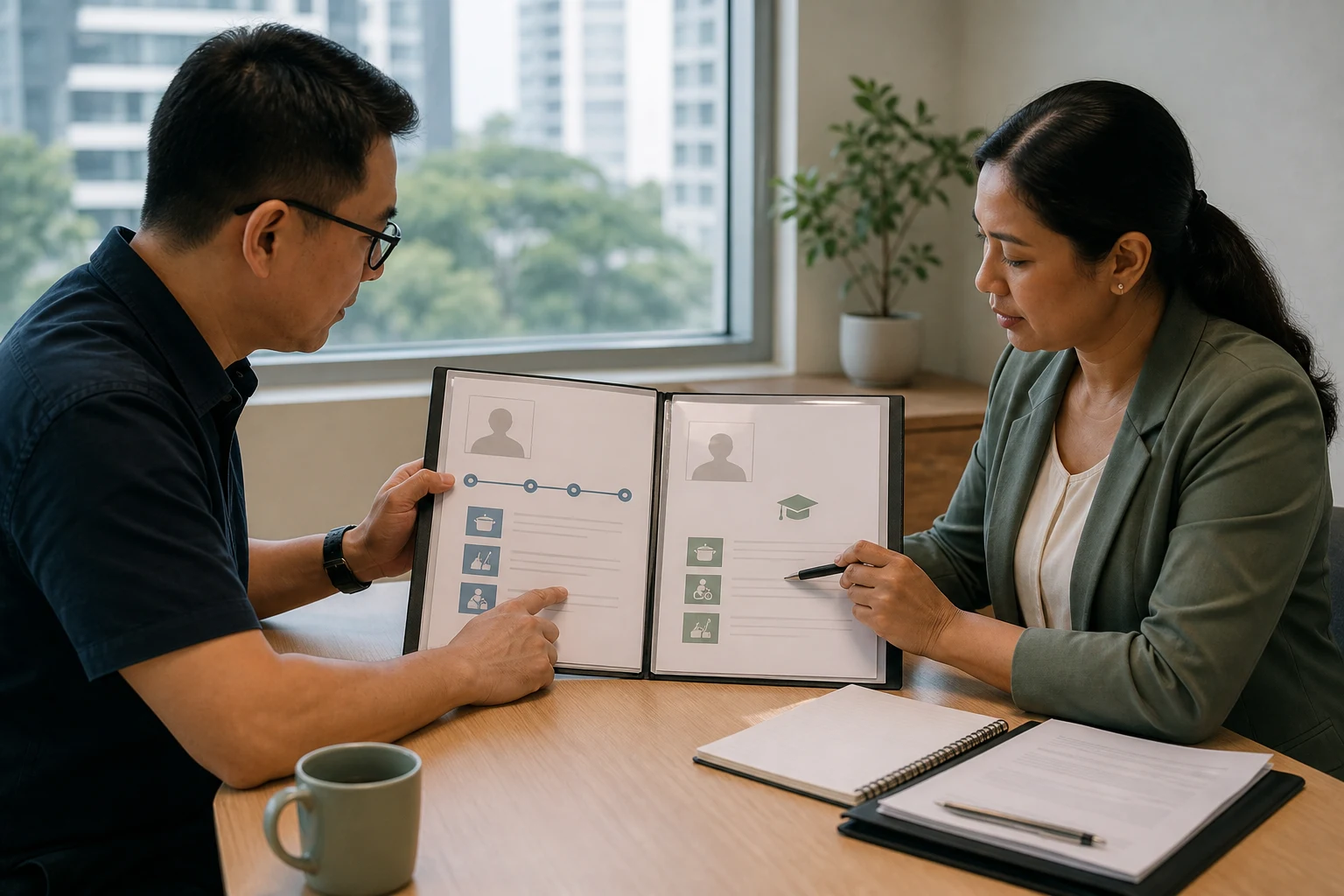
The choice between a new maid and an experienced maid in Singapore is not a simple contest between lower cost and better skill. “First-time in Singapore” does not always mean no work experience, and “experienced” does not guarantee relevant experience. Compare the person, the evidence, and your household's ability to train. Browse first-time helper biodata and experienced helper biodata with the same role description.
Quick answer
Choose an experienced helper when the verified work history closely matches a complex role and your family has limited time for basic orientation. Consider a first-time Singapore helper when the candidate has suitable underlying skills, communicates well, and your household can provide patient, structured training. In both cases, verify history, use scenario interviews, agree written terms, and plan a realistic first month.
Define the labels before comparing
A first-time Singapore helper may have cared for relatives, worked domestically in her home country, or held a job elsewhere. An experienced helper may have worked in Singapore, another overseas market, or both. Ex-Singapore describes past local experience; transfer describes a helper currently changing Singapore employers. Ask the agency exactly how each listing type is assigned.
| Decision area | First-time Singapore helper | Experienced helper |
|---|---|---|
| Evidence to check | Training, home-country work, caregiving, language, and learning examples | Official record, placement duties, outcomes, references, and relevance |
| Orientation need | May need more time with local appliances, transport, high-rise safety, and routines | May know local routines but must unlearn assumptions from another home |
| Best fit may be | Predictable role with patient supervision and clear training | Complex role closely matching verified prior duties |
| Main risk | Employer underestimates training and adjustment time | Employer assumes experience transfers automatically |
| Interview focus | Learning, safety judgment, communication, and transferable skills | Specific past duties, decisions, reasons for leaving, and current expectations |
Start with your household risk and training capacity
Write the non-negotiable duties, then ask how much supervision the family can realistically provide. Newborn care, transfers for a frail senior, severe allergies, complex diets, multiple young children, or a reactive pet may justify closely matched verified experience. A steady household with predictable routines and an available trainer may be able to support a strong first-time candidate.
- Who can demonstrate routines every day during the first two weeks?
- Which tasks carry immediate safety consequences?
- Can duties be reduced while the helper learns?
- Are written, visual, or translated instructions available?
- What backup care exists for rest days, illness, appointments, or training?
- Will every family member give consistent instructions?
Know the extra first-time Singapore requirements
MOM says a first-time migrant domestic worker must attend the one-day Settling-In Programme within seven days of arrival, excluding Sundays and public holidays, and can start work only after attending. The programme covers adapting to Singapore, employment conditions, working safely, and relationship and stress management. Check the current MOM Settling-In Programme requirements when planning the arrival timeline.
MOM also requires first-time MDWs to attend interviews twice in their first year so their adjustment, well-being, and working conditions can be checked. The employer must ensure attendance. Review the current MOM migrant domestic worker interview guidance.
Verify experienced-helper claims carefully
For prior Singapore employment, MOM says prospective employers can check the record through the FDW eService using Singpass and the required helper details, or ask the employment agency to check. Follow MOM employment-history instructions. Then interview for the duties behind the dates: household size, care intensity, independence, reasons for leaving, and lessons learned.
Use different questions, but the same scoring standard
First-time candidates need room to show transferable skills and learning judgment. Experienced candidates should give concrete examples that support their claims. Score both on safety, relevant skill, communication, honesty, expectations, and ability to ask for help.
| First-time Singapore helper | Experienced helper |
|---|---|
| Tell us about a difficult skill you learned and how you practised it. | Walk us through the most relevant household you worked in. |
| What would you do when an appliance or instruction is unfamiliar? | What did you handle independently and what did the family handle? |
| How would you ask for clarification after making a mistake? | Describe a misunderstanding and how it was resolved. |
| Which duties are you confident doing and which need training? | Which of our duties are genuinely new despite your experience? |
| How do you expect the first month in Singapore to feel? | Which habits from past homes might need to change here? |
Compare total fit, not a single headline price
Salary expectations, agency fees, arrival steps, training time, and replacement terms may differ by candidate and agency. Do not assume every new helper costs less or every experienced helper costs more. Request a written fee breakdown and compare the full role using the 2026 maid cost guide without using nationality as a proxy for skill or pay.
Build a first-month plan for either choice
- Days 1–3: accommodation, food, privacy, emergency contacts, safety, and essential routines
- Week 1: demonstrate tasks and use teach-back for safety-critical steps
- Week 2: let the helper lead familiar tasks while the employer observes and answers questions
- Weeks 3–4: review workload, communication, rest, food, sleep, care routines, and training gaps
- End of month: agree what to keep, simplify, retrain, or document more clearly
MOM encourages written employment terms and requires the applicable safety agreement. Rest-day rights apply regardless of experience: one rest day per week, with at least one rest day each month that cannot be compensated away. Review MOM contracts and safety guidance and MOM rest-day and well-being guidance before deployment.
Sources and review note
Last reviewed 25 August 2026. Primary references: MOM Settling-In Programme, first-year interview, employment-history, contract, safety, rest-day, and well-being guidance linked above.
Frequently asked questions
Is a new maid or experienced maid better in Singapore?
Neither is automatically better. An experienced helper may bring relevant routines and references, while a first-time helper may be open to structured training. The better fit depends on care complexity, training time, verified history, communication, expectations, and agency support.
What does first-time helper mean?
For Singapore onboarding requirements, a first-time migrant domestic worker is someone working in Singapore for the first time. This is different from having no domestic-work or caregiving experience anywhere; ask where and what she has done before.
Does an experienced helper still need training?
Yes. Prior experience belongs to another household with different people, equipment, rules, diets, care plans, and communication. Every helper needs a safe, household-specific handover and clear written priorities.
Official references
These primary references support the guide. A verification date is shown only after a dated editorial review.
- Settling-In Programme requirements — Ministry of Manpower Singapore (checked 25 Aug 2026)
- Migrant domestic worker interview — Ministry of Manpower Singapore (checked 25 Aug 2026)
- Check a migrant domestic worker employment history — Ministry of Manpower Singapore (checked 25 Aug 2026)
- Contracts and safety agreement for migrant domestic workers — Ministry of Manpower Singapore (checked 25 Aug 2026)
- Rest days and well-being for migrant domestic workers — Ministry of Manpower Singapore (checked 25 Aug 2026)